

Sewers and wastewater · Drain and underground drain
Drain and pipe cleaning in Vienna, Lower Austria and Burgenland
A blocked drain is a nuisance, a blocked underground drain a risk to the building. CFT clears the blockage with special tools and then checks with the inspection camera whether deposits really were the only cause. Because a pipe that closes up again after every cleaning does not have a cleaning problem but a structural one. We work in Vienna, Lower Austria and Burgenland: a short journey and appointments at short notice. Report the blockage on +43 (0) 2252 53169 or in writing to office@cft.at, and we will settle access and the appointment.

What we do on site
We work up to the blockage from the nearest cleaning access, release it and flush afterwards so that what has come loose does not settle at the next constriction. We then check the result and tell you whether the blockage was chance or symptom. If there is a structural cause, we name it.
Key facts at a glance
| Methods | Mechanical unblocking with special tools, high-pressure cleaning for drains and sanitary pipes, visual check with the inspection camera |
|---|---|
| Application range | Drains, sanitary pipes |
| Duration | Typically 2 to 4 hours, strongly dependent on the type and accessibility of the blockage. |
| Result format | Clear cross-section, drain checked, camera check during and after cleaning, statement of structural causes where identifiable |
| Service area | Vienna, Lower Austria and Burgenland |
What this means for you
The drain gurgles, the water stands in the shower, in the washbasin it comes back up. Usually hair, grease, food residue or deposits are behind it, and they rarely sit where you would expect them – the visible trap is often clear, the blockage lies metres further along the pipe run. We work our way in from the nearest rodding eye, flush the section clear and check with the camera; if root ingress, a displaced pipe or a fragment of broken pipe becomes visible in the process, we tell you – and not only at the third visit.
How the job runs
1. Taking the details by telephone. We ask which drain is affected, since when, whether several outlets are affected and whether it has already surcharged. From this it follows whether a single pipe or the main underground run is the problem.
2. Providing access. You clear the area around the drain, rodding eye or manhole and, as far as possible, leave the affected outlets unused until the appointment.
3. Cleaning. We release the blockage – mechanically or with the high-pressure unit for drains and sanitary pipes, depending on its position and type – and flush afterwards so that what has been released does not settle at the next constriction.
4. Checking and handover. We check the drain visually with the inspection camera. If a structural cause shows up, we name it.
Equipment and methods
Mechanical unblocking
Hard, compact blockages and root material can be released with a rotating tool that is guided through the pipe. That is the way forward when flushing water can no longer drain away or the blockage is firmly wedged.
High-pressure cleaning for drains and sanitary pipes
High-pressure cleaning is usually a method for underground drains and sewers – for the small cross-sections inside the building we use a special high-pressure unit built precisely for that purpose: with it, drains and sanitary pipes can be cleaned at high pressure. The water jet releases grease, soap and limescale deposits from the pipe wall and carries them away instead of merely boring a hole through the blockage. Afterwards the cross-section is clear, not merely passable – and that is exactly what the camera then checks.
Visual check with the inspection camera
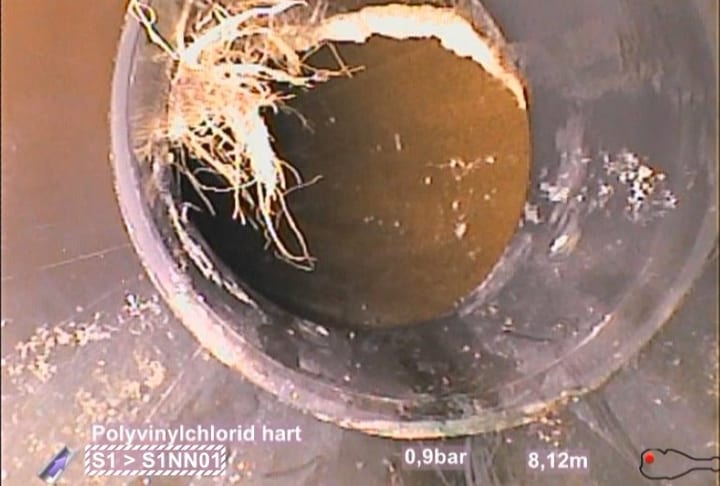
During and after cleaning we check the result with the inspection camera. This provides evidence that the cross-section is clear, and it becomes visible whether a cause remains behind: displacement at a joint, roots through a leaking connection, back fall, broken sections.

What you receive
You receive a clear, checked drain and the statement as to whether the blockage was chance or a symptom. If a structural cause is identifiable, we name it.
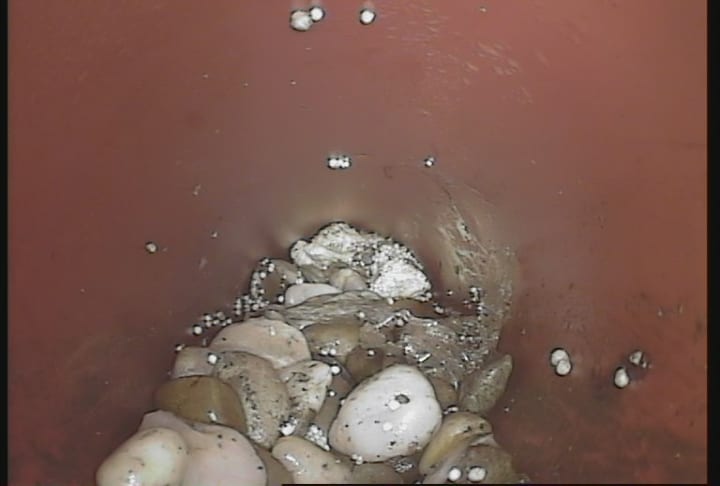
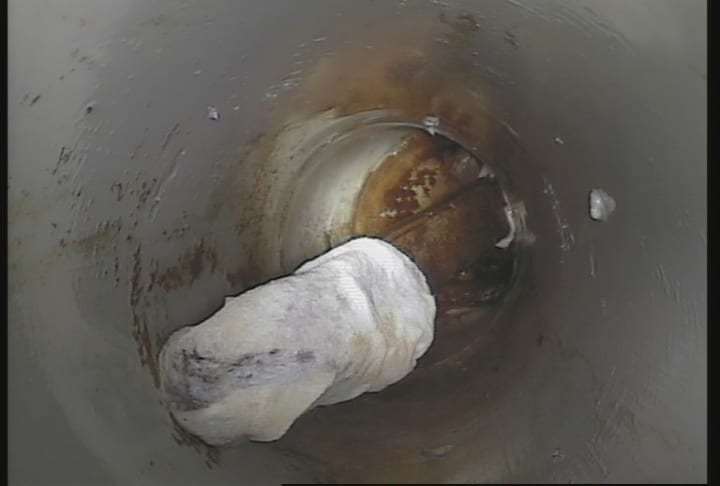
From the archive: what blocks pipes.
Three stills from real surveys – with the stationing as the camera writes it.
Costs and effort
We do not quote a flat rate, because the position of the blockage, accessibility, pipe length and the type of deposit determine the effort; we agree the cost range by telephone before the job. Clearing a blockage on its own is not usually an insurance matter – it is different where surcharge has already caused water damage.
Frequently asked questions
Why does the same pipe block again and again?
Because cleaning removes the deposit, not its cause. A recurring blockage at the same place points to back fall, a displaced joint, root ingress or loss of cross-section – that only becomes visible with the camera in the cleaned pipe.
Do chemical drain cleaners help?
They rarely release the blockage and can make access more difficult where water is standing. If you have used such a product, please tell us before the appointment – that is a matter of occupational safety.
Can the cleaning damage my pipe?
With visibly damaged pipes we work more cautiously or go in with the camera first. Where a pipe is suspected of being brittle, the camera is the first step and not the last.
Do you also clean solely to prepare for a survey?
Yes. Before a CCTV or 3D survey, cleaning is a precondition in any case – deposits cover exactly what is to be assessed – and the two can be combined in one appointment.
Contact and opening hours
For Vienna, Lower Austria and Burgenland: CFT Group GmbH, Wiener Straße 99, A-2514 Traiskirchen, +43 (0) 2252 53169, Monday to Thursday 8:00–16:30, Friday 8:00–12:00. Outside office hours in writing to office@cft.at, and we will come back to you on the next working day.
Related services
Describe what you are observing.
Just describe what you see – add a photo, and we can often settle on the right method before we even call back.
What happens next
- We read your message and match the case to a method.
- We come back to you – usually with a question that shortens the appointment.
- We confirm the appointment and what it costs before anyone sets off.
Rather talk?
+43 (0) 2252 53169
Mon–Thu 8:00–16:30 · Fri 8:00–12:00
Describe your case.
Fastest by telephone – then we settle straight away which method fits and what you should prepare.
Outside office hours, write to office@cft.at.