

Leak detection
Water damage investigation on buildings in Vienna, Lower Austria and Burgenland
A wall goes dark, the cellar smells musty, the parquet is lifting – and nobody knows where the water is coming from. The water damage investigation answers that question: which source, which path, which area. It comes before the remedial work, because the cause has to be established first, and only then is drying and repair carried out. Describe the damage on +43 (0) 2252 53169 or in writing to office@cft.at, and we will settle access to the affected rooms and the appointment.

What we do on site
We first map the damp area and its edges and note the dry measuring points as well, because they bound the damage on the outside. From there we work back to the source and rule out the plausible causes one by one. You receive a detailed photographic report with a precise description of the damage and its cause, so that it is clear which trade you need.
Key facts at a glance
| Methods | Moisture measurement, thermography, borescope inspection, camera-based pipe inspection, pressure test for elimination |
|---|---|
| Application range | Walls, floors, ceilings, cellars, building envelope, terrace and balcony details, roof structure |
| Duration | Typically 3 to 6 hours; with check appointments the investigation can extend over several days |
| Result format | Detailed photographic report with a description of the damage and the party responsible |
| Service area | Vienna, Lower Austria and Burgenland |
For you as a private customer
The most common mistake is to assume that the wet spot is also the leaking one. Water runs on along pipes, in insulation layers and on concrete slabs and comes out metres away, often a storey lower. We therefore first measure the extent of the moisture and work our way back to the source. In the end you know whether it is a pipe, the waterproofing, the roof, rising damp or condensation – and hence which trade you need.
For you as a business
For managing agents, property developers, experts and insurers, the attribution of the cause is the basis for settling the claim. In the report we separate finding and assessment: measured values with measuring point and method on the one side, the assumed cause derived from them on the other. A mapping with dated measuring points can be repeated, so that spread or drying back can be documented.
How the job runs
1. Recording the damage by telephone. We ask how long the spot has been damp, whether it is increasing, whether it gets worse after rain and what lies above and below it structurally. That decides which measuring equipment we bring.
2. Preparation on site. The affected areas have to be accessible; please remove furniture, carpets and linings beforehand. Plans, older plumbers’ invoices and photographs from when the damage started are useful.
3. Investigation. We map the damp area and its edges, then we check the plausible sources one after another and rule them out individually. Every measuring point is noted, including the dry ones – they delimit the damage at the outside.
4. Report and handover. You receive the mapping and the investigation report with the attribution of the cause and the recommended measure. With that you go to the plumber, the roofer or the waterproofing contractor – and to your insurer.
Equipment and methods
Moisture measurement
Two measuring principles complement one another: capacitive instruments scan the zone near the surface non-destructively and are suited to walking an area quickly; resistance measurements with electrodes give values from a defined depth but require small pin holes. Both give comparative values, not absolute ones – salts from earlier damage raise the reading of the resistance measurement, while metal and varying bulk density interfere with the capacitive one. An absolute moisture content can only be obtained by way of an oven-dry test or a carbide (CM) moisture test.
Thermography
Damp building elements are cooler than dry ones because of evaporation, which is why the saturated area often stands out in the thermal image with recognisable edges. A thermal image shows temperature, not moisture – thermal bridges and heating circuits produce similar pictures, which is why every suspicion is confirmed with a moisture measurement.
Borescope inspection
If the suspicion lies in a void – suspended ceiling, dry lining, screed insulation layer, services duct – a small camera is introduced through a hole a few millimetres across. In this way standing water, run marks and corrosion become visible without opening up the construction.
Camera-based pipe inspection
If a wastewater or rainwater pipe is under suspicion, a camera is run through it: cracks, open joints, root ingress and misconnections become visible, and the defect can be marked at the surface by means of a sonde. Fine cracks in sections that are full remain hidden.
Pressure test for elimination
In order to rule out a pipe as the cause, the section is isolated and it is observed whether the pressure holds. This separates water from the pipework from moisture out of the structure, but it does not say where the section would be leaking.

What you receive
You receive a moisture mapping with numbered measuring points, reading, method and details of the material, along with the investigation report with the attribution of the cause and the follow-up measure; the photographic report and, where used, thermal images are enclosed.
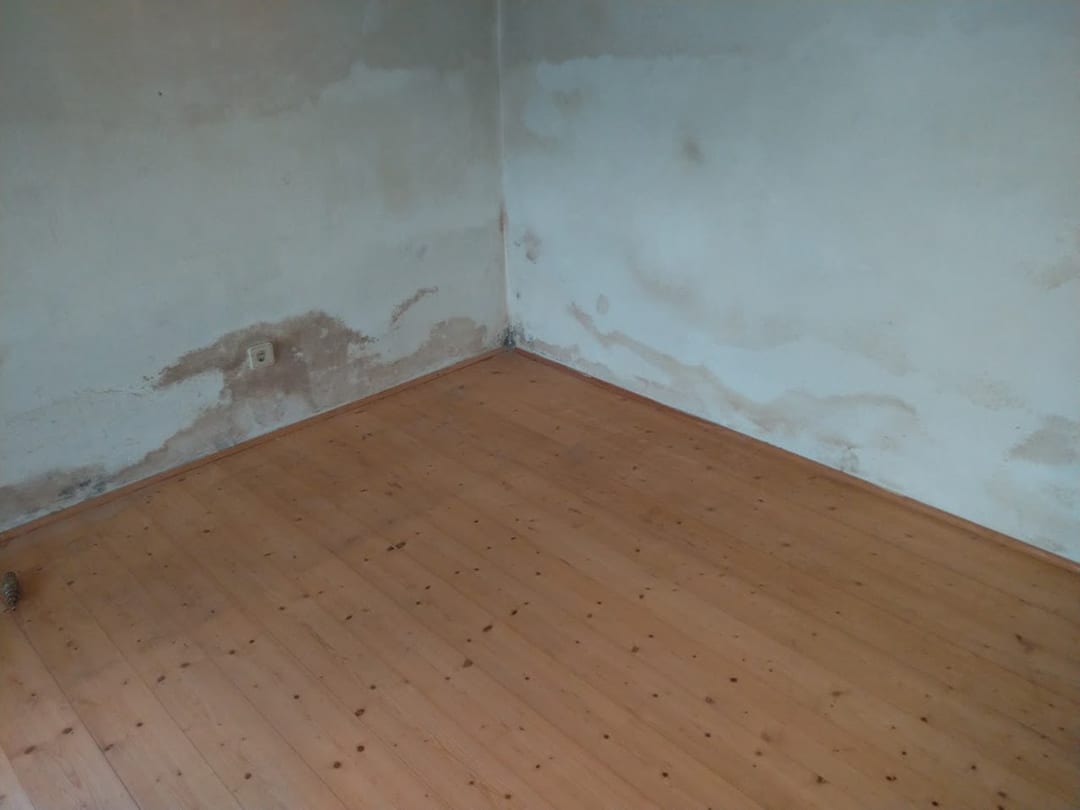
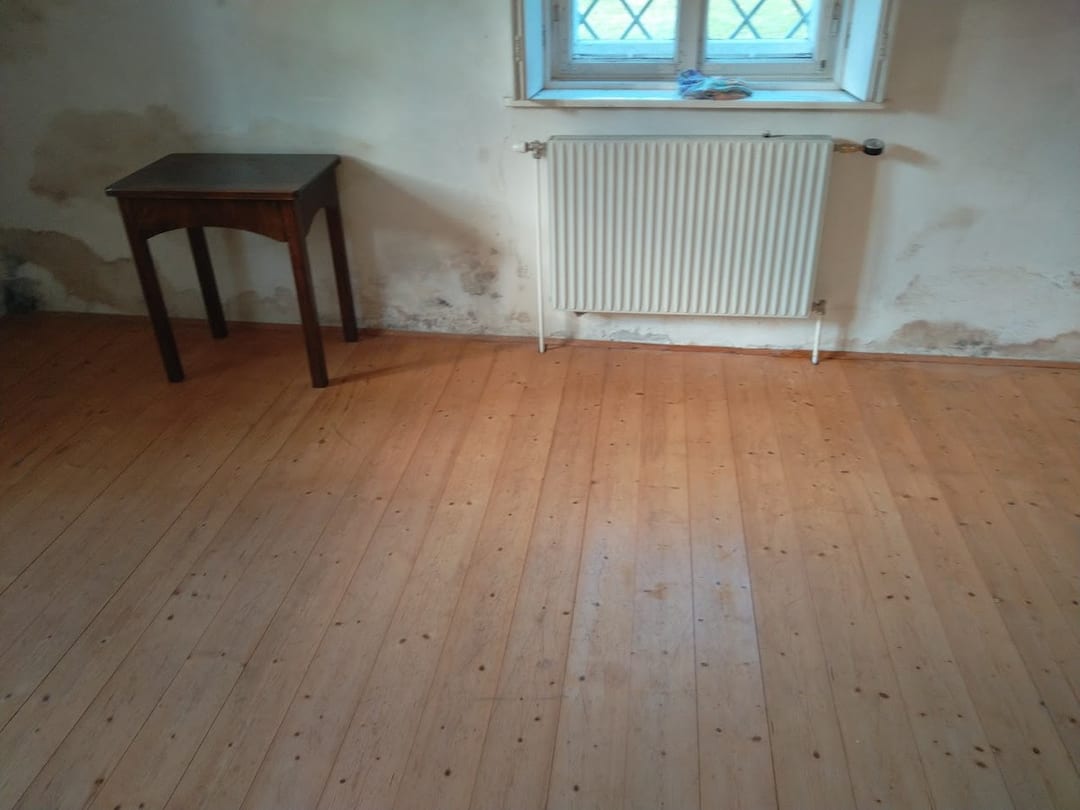
When nothing drips – and the wall gets damp all the same.
No meter turning. No pipe hissing. Exactly here the water damage investigation begins.

Costs and effort
There is no flat-rate price, because the extent and the choice of method depend on the damage pattern – a damp wall is something different from damage across three storeys. We agree the cost range by telephone before the job. With an escape of water, buildings insurance will as a rule pay the leak detection costs under trace and access cover; we produce the report so that it can be submitted for that purpose.
Frequently asked questions
You measure in one place, but it is damp somewhere else. Why?
Because water follows the fall, not visibility: it runs on along pipes and structural floor slabs and emerges where the build-up allows. The mapping therefore looks for the edge of the damp area and its highest point.
Is mould automatically water damage?
No. Mould also arises from condensation on cold building elements, with no pipe involved at all. Moisture from a leak shows a different depth profile from surface condensation.
Can you say how long the damage has existed?
No measurement provides a reliable dating. We document the condition on the day of measurement, and if the measurement is repeated we can document spread or drying back.
Do you dry out the damage as well?
Not ourselves. We take on the moisture measurement, the extent of the damage, the drying plan and the check measurement that documents the condition reached; the equipment is supplied and operated by a partner firm whom we can put you in touch with. The procedure is described under Structural drying. As long as water keeps running in, no drying takes place in any case, since otherwise the drying works against a running source.
Contact and opening hours
CFT Group GmbH in Traiskirchen, +43 (0) 2252 53169, Monday to Thursday 8:00–16:30, Friday 8:00–12:00 – responsible for Vienna, Lower Austria and Burgenland. Because we travel from Traiskirchen, the distances stay short, an on-site appointment is quickly found and the local forms of construction are familiar to us. Outside office hours in writing to office@cft.at, and we will come back to you on the next working day.
Describe what you are observing.
Just describe what you see – add a photo, and we can often settle on the right method before we even call back.
What happens next
- We read your message and match the case to a method.
- We come back to you – usually with a question that shortens the appointment.
- We confirm the appointment and what it costs before anyone sets off.
Rather talk?
+43 (0) 2252 53169
Mon–Thu 8:00–16:30 · Fri 8:00–12:00
Describe your case.
Fastest by telephone – then we settle straight away which method fits and what you should prepare.
Outside office hours, write to office@cft.at.