

Cable faults
Cable fault location on thin-bed electric heating mats and heating cables throughout Austria and southern Germany
The bathroom stays cold in the morning, only part of the floor in the living room warms up, the protective device trips when the heating is switched on. With thin-bed electric heating mats and heating cables the fault lies under tiles or screed, and the obvious answer would be to open up the floor. CFT locates the fault position and marks it on the covering, so that one area is opened up instead of a whole room. For this we travel from Traiskirchen throughout Austria, and from Erding to Bavaria and Baden-Württemberg; a site appointment is available at short notice. Describe the failure to us by telephone on +43 (0) 2252 53169 or in writing to office@cft.at, and we will clarify the method, access and an appointment.

What we do on site
On the isolated heating circuit we first measure insulation and resistance: that establishes whether the heating conductor is interrupted or shorting against the protective braid. The time-domain measurement says how far along the conductor the point lies; the burn-down generator heats the mat until the thermal imaging camera shows route and fault position at the surface of the covering. Opening up and repair are normally done by your electrician.
Key facts at a glance
| Methods | Insulation and resistance measurement, time domain reflectometry (TDR), burn-down generator for heating up, sheath fault location, thermography (thermal imaging) |
|---|---|
| Application range | Electric underfloor, wall and ceiling heating in living areas; thin-bed electric heating mats under tiles, heating cables in the screed and in the floor construction |
| Duration | Two hours as the lower limit, one further hour per additional complication. One or two faults are usually dealt with in that time. |
| Result format | Damage report as a PDF |
| Service area | The whole of Austria from Traiskirchen; southern Germany, that is Bavaria and Baden-Württemberg, via CFT Group Deutschland GmbH, Lange Zeile 27, D-85435 Erding |
For you as a private customer
You notice the fault from the cold zone: one part of the floor warms up, another does not, or the heating no longer comes on at all. A common cause is mechanical damage – a drill hole for the shower screen, a wall plug, a knock while the covering was being laid. Without fault location the floor is opened up until something is found – with tiles, in the worst case the whole room. We locate and mark the position; opening up and repair are carried out by your electrician.
For you as a business
For electrical contractors, maintenance companies, tilers, property developers and managing agents the report is the evidence: it records the finding, the method and the readings and shows why the covering was opened up at that point – which counts when a preceding trade damaged the mat while the floor was being laid. We locate and mark; opening up and repair are usually carried out by your own contractor.
How the job runs
1. Booking and details of the construction. You describe which area stays cold and since when. An installation record, photographs taken during construction and information on whether the mat lies in the thin bed, in the screed or in the concrete are helpful.
2. Isolation and initial findings. The heating circuit is isolated and de-energised and disconnected from the thermostat and the distribution board; as a rule your electrician does this, and we take it on if you wish – please say so when you book. We classify the fault: open circuit, a fault to the protective earth braid, or a fault at the cold tail connection.
3. Heating up and narrowing it down. The burn-down generator puts power onto the heating conductor until it stands out from the surrounding construction. The thermal imaging camera then traces the loops and turning points at the covering, and where the fault sits the image deviates – this is what turns the measured length into a position in the room.
4. Marking and handover. The position is marked on the covering and photographed, and the report goes to you. Opening up and repair are normally carried out by your electrician; if you expressly wish it, we also carry out the repair ourselves on thin-bed electric heating mats and heating cables.
Equipment and methods
Insulation and resistance measurement
Before any location work comes the question of which fault is present: the resistance of the heating conductor is measured against the design value for the circuit, and the insulation against the protective earth braid. If the heating conductor has an open circuit, the work is based on time domain reflectometry; if there is a fault to the braid, it is based on sheath fault location. Where several circuits lie under one area, the same finding also establishes which circuit is affected at all.
Time domain reflectometry (TDR) on the heating conductor
The pulse travels as far as the open circuit and is reflected there; the transit time gives the length of the sound section, and in relation to the total installed length it shows which loop the fault sits in. The velocity factor (VoP) for heating conductors is not stored in the instrument and is calibrated against a sound circuit of identical construction; without this the reading in metres can only be read as a relative value, and very long heating circuits reach the limit of the measuring range. A figure only becomes a position in the room once the run from the thermal image is added to it.
The length does not only count for the location work. Heating mats come prefabricated from the manufacturer, with a defined output and a maximum load that may sit on the circuit. If the mat is shortened, the ratio of conductor length to applied output shifts – which is why the length actually installed has to be known before anybody intervenes.
Sheath fault location
If there is no break but a fault to the protective earth braid, the covering of the heating conductor is damaged. For location, a pulsed direct current is fed in which leaves the conductor at the damaged point; the voltage gradient this produces is picked up at the surface and reverses direction directly above the fault. Heavily reinforced concrete blurs this gradient – there the combination of heating up and the thermal image carries the work further.
Burn-down generator for heating up
The heating conductor lies under tiles, screed or concrete – it cannot be seen, but it can be heated. The burn-down generator applies enough power for the conductor to stand out from the surrounding construction and show through at the surface as a heat pattern. Two things become visible with it: the installed run with its loops and turning points, and the fault position itself, once energy is applied there deliberately and the spot becomes hotter than its surroundings. How quickly and how clearly this comes through depends on the depth of the construction and on the covering: a thin bed under tiles shows early, thick screed needs time.
Thermography (thermal imaging)
The thermal imaging camera is the eye for the burn-down generator: it makes visible what the generator has put into the floor. The heated conductor shows as a pattern, and where the pattern breaks off, reverses or shows a locally limited excess temperature, that is where the fault sits. Without heat applied it stays silent, because a mat with an open circuit is equally cold everywhere. The two methods therefore belong together and are not used separately.

What you receive
You receive a marking directly on the covering and a damage report as a PDF. It contains the finding, the method, the readings, the recorded run and the photographs of the marking, together with the thermal images from the location work. This makes it possible to show why the covering was opened up at that point.
On request we open up and repair the position ourselves. Otherwise our work ends with location, marking and report – the opening up is done by a specialist contractor. With underfloor heating, thin-bed electric heating mats and heating cables we make an exception to this and repair the marked position ourselves. That saves you the second appointment and the handover in between: whoever took the measurements knows most precisely where the covering has to come up, and how far.
The usual route remains your electrician; both are open. Tell us when you book which of them you want – then it is settled before the job and not only once the marked position is lying in front of you.
We show what we find.
The same spot, photographed twice: on the left the floor as you see it – on the right what the thermal imaging camera sees once the heating is powered.
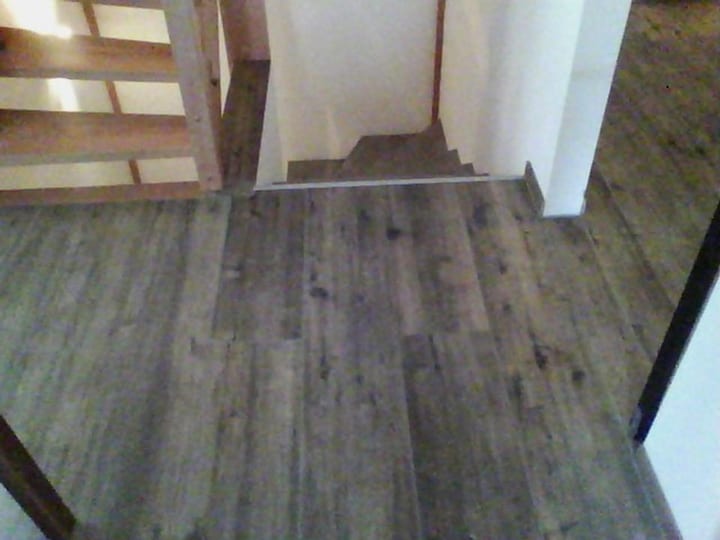
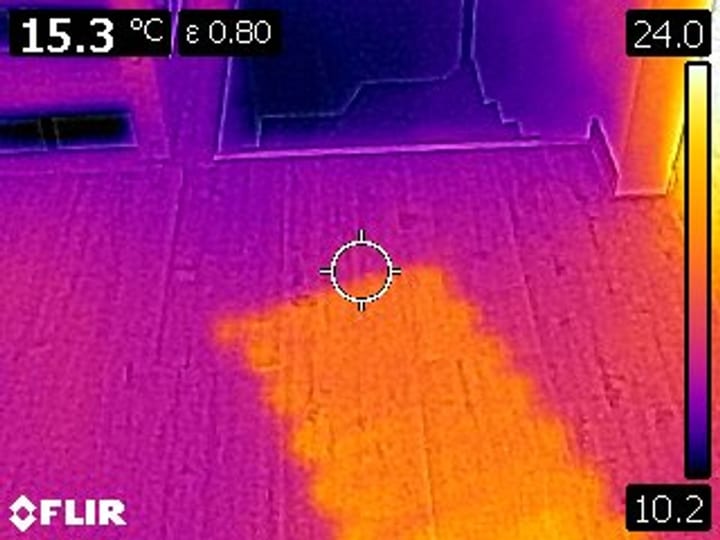
A floor gives nothing away. Under power the heated area shows itself within minutes – and a fault would stay dark.
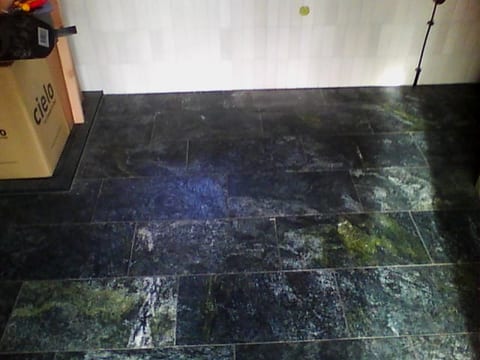
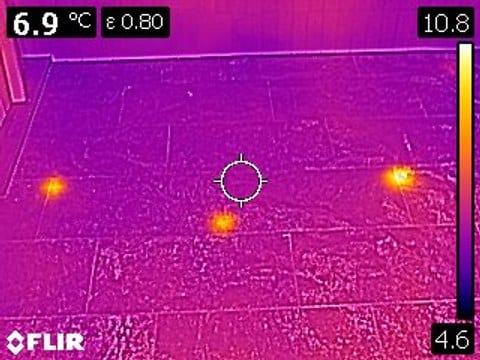
And the fault itself – drag the edge: under the unremarkable tiles the marked find points light up.
Costs and effort
No flat rate is quoted, because the size and construction of the heated area, the type of fault and the availability of the laying plan determine the effort involved; we agree the cost range with you by telephone before the job. Whether an insurer covers the location work depends on how the damage occurred and on the policy; trace and access cover relates to leak detection in cases of escape of water.
The re-survey is part of the scope of services. If opening up shows that our measurement was wrong, we re-survey free of charge. If our measurement was correct and the search at the marked position was simply not precise enough or the covering was not opened up far enough, we charge for the call-out, because in that case there is no measurement error on CFT’s part. This rule applies to every cable fault location, cable locating and pipe locating job.
Frequently asked questions
Does the floor have to be opened up for the location work?
No. The measurement is taken at the connection of the heating circuit, and the position is narrowed down at the surface. The floor is only opened up once the position has been marked, and then only at that spot – as a rule by your electrician.
And what if there is no fault at the marked position?
Then we carry out a re-survey; the re-survey is part of the scope of services. If our measurement was wrong, the re-survey is free of charge. If our measurement was correct and the search at the marked position was simply not precise enough or the covering was not opened up far enough, we charge for the call-out, because in that case there is no measurement error on CFT’s part. This applies equally to cable fault location, cable locating and pipe locating.
Does the floor covering have to be replaced when it is opened up?
That is decided by the covering, not by the measurement. With tiles, one tile is taken out and replaced; with seamless coverings the opening remains visible. That is why the position is narrowed down as tightly as possible before anything is opened up.
We no longer have the laying plan. Is it still possible?
Yes. The heating conductor is then heated up and the run traced with the thermal imaging camera – loops, turning points, connection. That takes additional time on site, but it replaces the plan.
Can a heating mat simply be shortened?
Not arbitrarily. The mat is prefabricated and designed for a particular length; the maximum load the circuit may carry depends on it. As a rule of thumb: no more than 20 per cent. Take away more and there is more power on less conductor than the manufacturer intended – the mat takes damage, often not at once but over the next heating seasons. That is why we measure the actual length instead of taking it from the laying plan.
How often may the same mat be repaired?
As a general limit, four repair joints. Beyond that the mat no longer works properly. Whoever sets the fourth should therefore know that there is no fifth – at that point the question is a new mat, not the next joint.
Does CFT also repair the position it has found?
If you expressly wish it, yes, but only on thin-bed electric heating mats and heating cables. For all other services our work ends with location, marking and report. Here too the normal case remains that your electrician opens up and repairs; if we are to take this on, we agree it before the job.
Can the mat continue to be used after the repair?
That is decided by whoever repairs the position and then tests the heating circuit – as a rule your electrician.
Is a measurement still needed after the repair?
Yes. As soon as the heating conductor has been cut for the repair there are two pieces, and both belong measured through before the covering goes back down. A mat that has been damaged in one place has often taken more during laying. Your electrician does that, or we do – it should not be left undone, because the second opening costs more than the measurement.
Contact and opening hours
For properties throughout Austria: CFT Group GmbH, +43 (0) 2252 53169, Monday to Thursday 8:00–16:30, Friday 8:00–12:00. Outside office hours, write to office@cft.at and we will come back to you on the next working day.
For properties in Bavaria and Baden-Württemberg: CFT Group Deutschland GmbH, Lange Zeile 27, D-85435 Erding, +49 (0) 173 6842932.
Related services
Service and supply cables
When the fault lies in the buried supply cable to the house.
Leak detection on heating systems
When it is not the electric mat that fails but the pressure of the water-borne heating that falls.
Telecoms, data and cable TV lines
When the data line in the same floor construction has failed as well.
Describe what you are observing.
Just describe what you see – add a photo, and we can often settle on the right method before we even call back.
What happens next
- We read your message and match the case to a method.
- We come back to you – usually with a question that shortens the appointment.
- We confirm the appointment and what it costs before anyone sets off.
Rather talk?
+43 (0) 2252 53169
Mon–Thu 8:00–16:30 · Fri 8:00–12:00
Describe your case.
Fastest by telephone – then we settle straight away which method fits and what you should prepare.
Outside office hours, write to office@cft.at.