

Cable faults
Cable fault location on ramp and stair heating throughout Austria and southern Germany
The access ramp ices over despite its embedded heating, the outdoor stairs stay cold, the protective device trips when the heating circuit is switched on. Under concrete, screed or paving there is no seeing where the heating cable is damaged – whoever searches without locating breaks open an area that afterwards has to carry traffic and feet again. CFT measures on the heating circuit and marks the fault position on top of the surface, so one panel is opened and not half the ramp. Traiskirchen is the base for the whole of Austria, Erding for Bavaria and Baden-Württemberg. A site date is available at short notice – which counts once the frost period is already running. Report the failure by phone on +43 (0) 2252 53169 or in writing to office@cft.at, and we will discuss method, access and date.

What we do on site
Where several circuits lie beneath one surface, insulation and resistance first establish which one has failed and whether the heating conductor is severed or shorting against the protective braid. The time-domain measurement gives the distance along the conductor; the burn-down generator heats the circuit until the thermal imaging camera shows route and fault position at the top of the ramp. Marking and photographs go to you with the damage report as a PDF; breaking open and repair are normally done by your specialist contractor.
Key facts at a glance
| Methods | Insulation and resistance measurement, time domain reflectometry (TDR), burn-down generator for heating up, sheath fault location, thermography |
|---|---|
| Application range | Electric open-area heating: access and underground-garage ramps, outdoor stairs and landings, driveways, loading yards and walkways; heating cables and mats in concrete, screed and under paving |
| Duration | Basic job two hours, one hour on top for each complication. One or two fault positions usually lie within that. |
| Result format | Damage report as PDF |
| Service area | The whole of Austria from Traiskirchen; southern Germany, that is Bavaria and Baden-Württemberg, via CFT Group Deutschland GmbH, Lange Zeile 27, D-85435 Erding |
For you as a business
A failed ramp heating becomes a problem with the first frost, and then immediately: the area must be gritted or closed as long as it does not heat. For property managers, facility service providers, developers, maintenance companies and electrical contractors the locating also decides whether a complaint turns into a dispute. The findings record where the damage sits and how it presents in the measurements – which counts when several trades have worked on the same build-up. From us come locating, marking and report; opening and repair are usually done by your own contractor.
How the job runs
1. Registration and details of the build-up. You describe which part of the area stays cold and ices over, since when, and whether only a section is affected. The laying record and construction photographs help, as do the assignment of the heating circuit distributor and the build-up above the cable – concrete, screed or paving bed.
2. Isolation and basic findings. Before the measurement the circuit is isolated and disconnected from the open-area controller and the distributor. As a rule your electrician does this; we can take it over if agreed beforehand. If several circuits lie under one area, it is first established which one has failed; only then is the fault classified – severed heating conductor, fault at the cold-lead connection, or short against the protective braid.
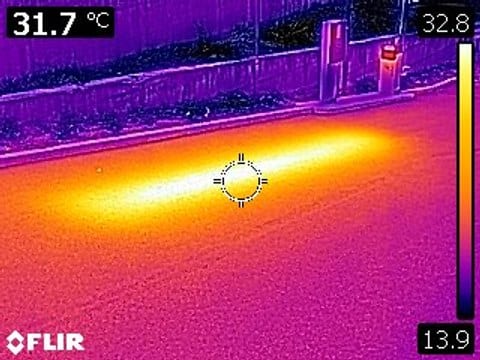
3. Heating up and narrowing down. The burn-down generator puts power onto the circuit until the conductor shows through at the top. The thermal imaging camera traces loops and turning points across the area, and where the pattern deviates, the spot sits. Only this turns the metre reading of the measurement into a point on the ramp.
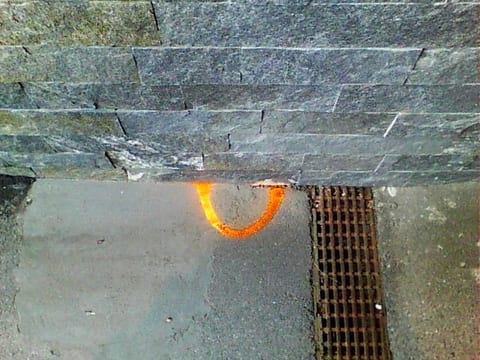
4. Marking and handover. The fault position is marked on the surface and photographed, then you receive the report. Opening and repair are as a rule done by your contractor; on express request we also carry out the repair of heating cables and thin-bed heating mats ourselves.
Equipment and methods
Insulation and resistance measurement
At the start stands not the where but the what: the resistance of the heating conductor is held against the circuit’s nominal value, plus the insulation against the protective braid. A severed conductor leads to time domain reflectometry, a short against the braid to sheath fault location. On an area with several circuits this finding also decides which circuit is pursued at all.
Time domain reflectometry (TDR) on the heating conductor
A pulse is applied to the heating conductor and returns from the break. The travel time yields the length of the still intact piece, and this length, set against the total length laid, says in which loop the fault sits. For heating conductors no velocity factor is held in the instrument; calibration is done on an identical intact circuit, otherwise the metre reading can only be read relatively. Extensive ramps and long open-area circuits push the method to its range limit – one reason to determine the affected circuit cleanly first.
Sheath fault location
If the heating conductor shorts against the protective braid instead of being broken, its sheath is damaged. A pulsed direct current exits at the damaged spot, the voltage gradient is scanned on top of the surface, and exactly above the fault it reverses direction. Ramps, however, are usually heavily reinforced, and reinforcement smears this gradient – where it does not narrow down enough, the combination of heating up and thermal imaging takes over.
Burn-down generator for heating up
Under concrete, screed or paving bed the heating conductor cannot be seen – but it can be heated. The burn-down generator applies enough power for the conductor to stand out from the surrounding build-up and show through at the top. This makes two things visible: the laid route with loops and turning points, and, with energy applied deliberately, the fault as a locally deviating spot. Open areas need more patience for this than a thin bed in a bathroom: ramp build-ups are thick, and frost or wet on the surface draws heat away.
Thermography
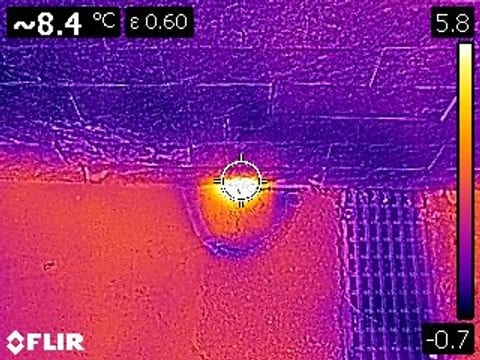
The thermal imaging camera reads what the burn-down generator has put into the area: the heated conductor shows as a pattern, and where it breaks off or shows a tightly bounded overtemperature, the spot sits. Outdoors the image additionally depends on the state of the surface – a closed layer of snow or ice falsifies it, the section must be cleared for it. Wet ramps cool unevenly, which lengthens the recording time.

What you receive
On the surface stands the marking, and with it comes a damage report as PDF. It contains the findings, methods used, measured values, the recorded route, photographs of the marked spot and the thermal images. Towards client and preceding trade this establishes why exactly there was opened – and whoever works on the same area later sees where the loops lie.
We deliver the locating, not the repair – you normally place that with your own contractor. On express request we open the marked spot ourselves and repair it; this is limited to heating cables and thin-bed heating mats and applies to none of our other services. Raise it when registering and it is settled before the job.
We show what we find.
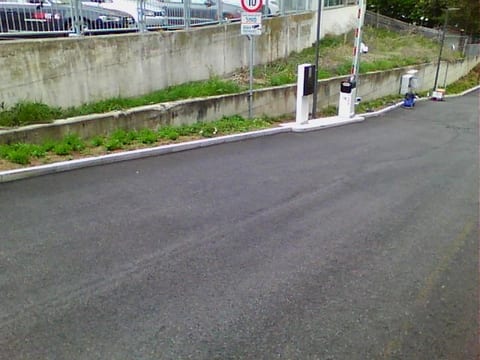
A ramp heating system at an industrial site – drag the edge: under the asphalt the heating loop draws its arc.
Costs and effort
There is no flat price: the size of the area, the number of heating circuits beneath it, the kind of fault and whether a laying plan exists determine the effort. We agree the cost range by telephone before the job. If the damage stems from a preceding trade, passing on the cost is a question of liability, not of measurement – the report provides the evidence for it.
Re-measurement happens within the job. If the opening shows that we measured wrongly, the re-measurement costs nothing. If the measurement held and the search at the marking was merely too imprecise or the opening too tight, we charge for the call-out – a measuring error by CFT is then not present. This is handled the same for every cable fault location, cable locating and pipe locating job.
Frequently asked questions
Does the area have to be broken open for the locating?
No. The measurement starts at the connection of the heating circuit, the narrowing happens on top of the surface. Opening starts only once the marking stands, and is limited to that one panel – as a rule carried out by your contractor.
Does the ramp have to be closed during the measurement?
The heating circuit is isolated for the measurement. For scanning the surface the marked zone must be freely accessible, without parked vehicles and without material on it. How long that takes depends on the size of the area.
Can measurements be taken in snow and ice?
The surface must be scannable. A closed layer of snow or ice hinders picking up the voltage gradient at the surface and falsifies the thermal image. We therefore schedule the date so that the affected section is cleared.
We no longer have the laying plan. Does it still work?
Yes. Then the circuit is heated and the route traced across the area with the thermal imaging camera – loops, turning points, connection. That costs extra time on site, but it replaces the plan and remains on record.
Can the heating circuit be tested before the frost period, before it fails?
Technically that is the same basic finding without a fault pattern: resistance of the heating conductor and insulation against the protective braid are measured and compared with last season’s values. A creeping deterioration shows up before the area is needed.
The area was opened and nothing was there. What now?
Then we re-measure, within the job. If our measurement was off, the re-measurement is free. If it held and the search at the marking was merely too imprecise or the opening too tight, we charge for the call-out – a measuring error by CFT is then not present. This applies equally to cable fault location, cable locating and pipe locating.
May a heating circuit be shortened?
Only within narrow limits. Heating mats come prefabricated from the manufacturer and are designed for a certain length, on which the permissible maximum load depends. As a rule of thumb, 20 per cent – take away more and more power sits on less conductor than intended, and the circuit is damaged. On an open area this often only shows in the next frost period.
How many repair points does a circuit tolerate?
Four repair sleeves, as a flat rule. Beyond that the circuit no longer works properly. For a ramp that has already been open twice this belongs in the decision: every further sleeve brings the area closer to the point where the circuit is replaced rather than patched.
Do you also repair the heating cable right away?
On express request yes, limited to heating cables and thin-bed heating mats. For every other service our work ends with locating, marking and report. The normal case remains your own contractor, who opens and repairs; if it is to run differently, that is agreed before the job.
Does it have to be measured again after the opening?
Yes, before the area is closed again. The repair cuts the heating circuit open; both sides must then be tested for further faults on the cable. For a ramp this weighs double: the build-up must be restored to carry traffic, and a second opening in the same season is expensive. This check is done by your contractor or by us.
Related services
Describe the findings.
The more precisely you describe the findings, the more directly we can go to work. Plans, readings and photos help us settle the method in advance.
What happens next
- We read your message and match the case to a method.
- We come back to you – usually with a question that shortens the appointment.
- We confirm the appointment and what it costs before anyone sets off.
Rather talk?
+43 (0) 2252 53169
Mon–Thu 8:00–16:30 · Fri 8:00–12:00
Describe your case.
Fastest by telephone – then we settle straight away which method fits and what you should prepare.
Outside office hours, write to office@cft.at.