

Leak detection
Burst and leak detection in and around buildings in Vienna, Lower Austria and Burgenland
The water meter is turning even though all the taps are closed. Or a wall is going damp and nobody knows which pipe runs behind it. CFT locates the leaking point on the pressurised pipe non-destructively, marks it on the building element and hands over a photographic report. We do not repair – we tell your plumber where to open up. For this we cover Vienna, Lower Austria and Burgenland: a short journey, appointments at short notice, familiar territory. Describe the case on +43 (0) 2252 53169 or in writing to office@cft.at, and we will settle access and the appointment.

What we do on site
We check every main and pipe in the vicinity of the damage. In a systematic process of elimination one suspect after another drops out until the cause is established. Every measurement is recorded digitally – from which a comprehensive photographic report for your insurer and your plumber is produced.
Key facts at a glance
| Methods | Pressure test with a record on cold water, hot water and heating pipes, moisture measurement, thermography, tracer gas, visual drain inspection, borescope inspection, dye flushing, water level tests, electromagnetic pipe locating and sonde location |
|---|---|
| Application range | Drinking water, hot water and circulation pipes inside the building, the supply pipe to the building, buried pipes on the property, wastewater pipes inside the building and on the property |
| Duration | Typically 2 to 4 hours |
| Result format | Marking of the defect at the surface, photographic report |
| Service area | Vienna, Lower Austria and Burgenland |
What this means for you
You rarely notice a burst pipe from the water itself, but from the annual bill, from a stain above the skirting board, from screed that is warmer in places, or from a rushing noise in the wall when everything is quiet at night. Nothing is broken open in order to have a look: measurements are taken from the outside, and opening up follows only once the point has been established. If the location work produces no clear finding, that is what the photographic report says, instead of guesswork.
How the job runs
1. Call and preliminary clarification. You describe the symptom: pressure loss, movement at the meter, a damp patch, an increased bill. We establish which pipes may be affected.
2. Preparation on site. Access to the meter, the manifold and the isolating valves has to be clear, and please move furniture away from the suspect wall. For the pressure test we isolate the section ourselves; tell us beforehand which areas may be without water in the meantime.
3. Location. We first narrow down the section, then the point, combining several methods as we go – no single one works in every building element. The find is marked, photographed and transferred to the sketch.
4. Handover. You receive the photographic report for your plumber and your insurer. The repair is carried out by your plumber; on request we re-survey afterwards.
Equipment and methods
Recorded pressure test on cold water, hot water and heating pipes
The suspect section is isolated and put under a defined pressure; over the holding time we record whether and how fast it drops. That separates the tight pipe from the leaking one before the actual leak search begins. Temperature changes in the pipe shift the pressure even without a leak – which is why it is recorded over time and not decided from one glance at the gauge.
Moisture measurement
Screed, plaster and insulation layer are scanned with moisture meters and the readings compared across the area. That shows how far the dampness reaches and where it is greatest. A single reading says little: salts in the masonry, residual moisture from construction and condensation produce similar readings. Only the pattern across many points gives a picture.
Thermography
A thermal imaging camera shows temperature differences at the surface; a hot water leak stands out as a plume. The camera sees temperature, not water – insulation layers, sunshine and underfloor heating produce similar patterns. Thermography narrows things down; on its own it proves nothing.
Tracer gas
The pipe is isolated, drained and filled with a test gas. The gas escapes at the defect, travels upwards through screed or ground and is indicated at the surface; dense floor coverings can divert it sideways.
Visual drain inspection
A camera is guided through the wastewater pipe and records the run. Cracks, fragments, roots, open joints and backwater can be proven on the picture, with the metre reading from the entry point. At the surface, damage can be marked directly by means of a built-in sonde. Prerequisites are an accessible entry point and a flushed pipe – on a coated pipe wall the camera does not see the damage.
Borescope inspection
Through a small drill hole a probe is guided into the cavity: pre-wall installation, shaft, suspended ceiling, screed void. That replaces breaking open at the suspect point – what lies behind the building element is seen, with an intervention of a few millimetres.
Dye flushing
A dye is added to the water and the suspect run is flushed. If the dye emerges at the damp spot, the path is proven: that separates wastewater from drinking water and one run from the neighbouring one. The method shows the connection, not the millimetre – the exact point is delivered by the locating methods.
Water level tests
An isolated area is filled and the water level is read over time – at manholes, basins and standing pipe sections. If the level falls, the section is leaking, and the drop per hour says how large the escape is. Evaporation on open surfaces is offset, otherwise you are measuring the weather.
Electromagnetic pipe locating and sonde location
Before the search it has to be clear where the pipe runs: a locating signal is applied to metallic pipes and traced at the surface, while a sonde is pushed into non-metallic pipes. Pipes running in parallel and reinforcement carry the signal across, which is why cross-checks are made at several points.

What you receive
The point found is marked on site – on the wall, on the screed or above the buried pipe. In addition you receive a photographic report with photographs of the marking and the methods used.
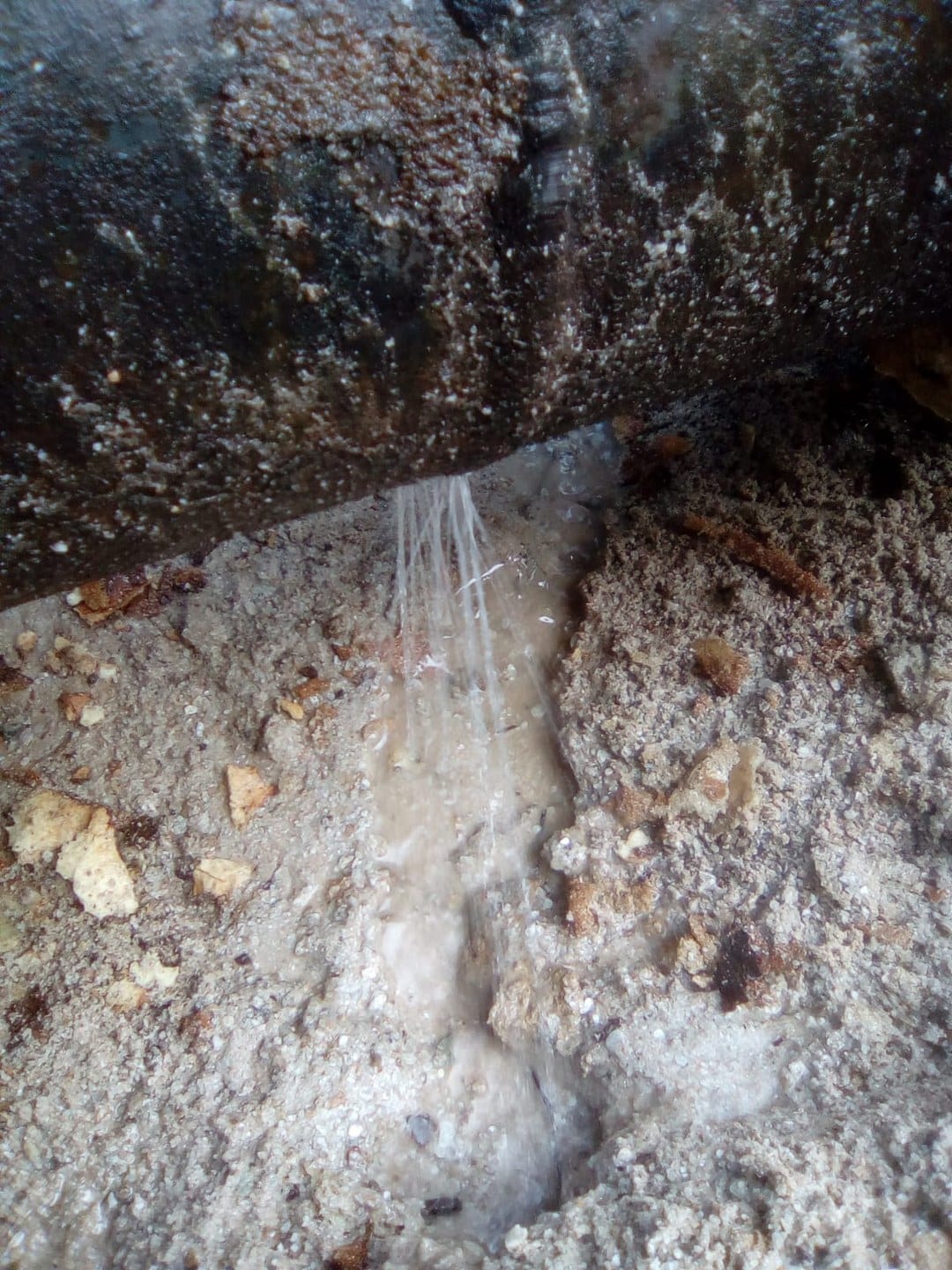
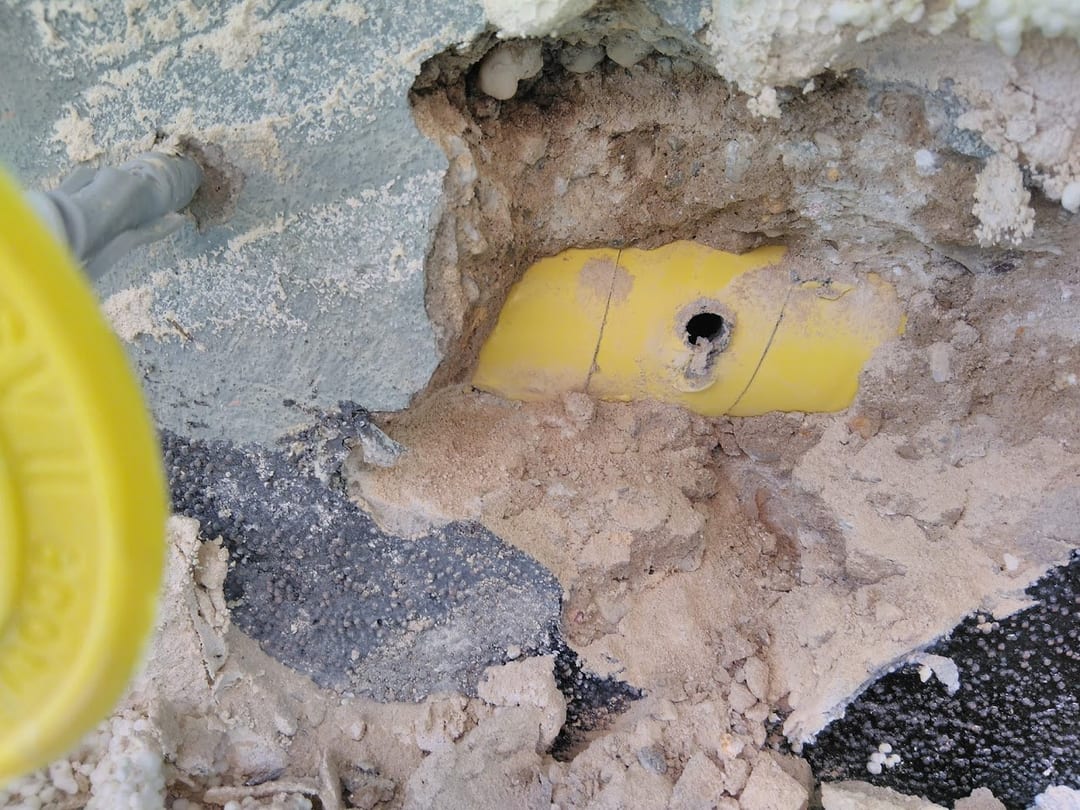
We show what we find.
From the first sign to the opened spot – all from real jobs.
Costs and effort
We do not state a flat rate, because the effort depends on the property, on accessibility and on the number of methods needed; we agree the cost range by telephone before the job. With an escape of water, buildings insurance will as a rule pay for the leak detection under trace and access cover – our photographic report is produced so that you can submit it.
Frequently asked questions
Do I have to turn the water off before the appointment?
No. Isolating and draining are part of the method and we do them ourselves: for the pressure test the section is isolated, for a tracer gas measurement it is drained as well. You only have to make sure that the meter, the manifold and the isolating valves are accessible and working.
My water meter is not moving – why is the wall damp all the same?
A meter that is not moving largely rules out the drinking water pipe, but not the heating, the wastewater, the rainwater or moisture from outside. Drawing that distinction is the task of the location work – it decides which trade is needed.
Is anything broken open during the location work?
No, all the methods named work from the surface. Opening up follows only after the location work, at the marked point, by your plumber.
And what if no leak is found?
Then that is what the photographic report says, together with the sections tested and the causes ruled out. That too is a result: it prevents digging in the wrong place.
Contact and opening hours
For properties in Vienna, Lower Austria and Burgenland: CFT Group GmbH, Wiener Straße 99, A-2514 Traiskirchen, +43 (0) 2252 53169. Monday to Thursday 8:00–16:30, Friday 8:00–12:00. Outside office hours in writing to office@cft.at, and we will come back to you on the next working day.
Related services
Water damage investigation
When the building envelope or the waterproofing is the cause.
Leak detection on heating systems
When the system pressure falls instead of the water meter running.
Structural drying
When drying is needed after the repair; the drying itself we refer on.
Pipe and utility detection
When the route of the pipe first has to be established.
Describe what you are observing.
Just describe what you see – add a photo, and we can often settle on the right method before we even call back.
What happens next
- We read your message and match the case to a method.
- We come back to you – usually with a question that shortens the appointment.
- We confirm the appointment and what it costs before anyone sets off.
Rather talk?
+43 (0) 2252 53169
Mon–Thu 8:00–16:30 · Fri 8:00–12:00
Describe your case.
Fastest by telephone – then we settle straight away which method fits and what you should prepare.
Outside office hours, write to office@cft.at.