

Sewers and wastewater · DN 100–1200
CCTV pipe run survey of collector sewers in Vienna, Lower Austria and Burgenland
A sewer defect only announces itself at the surface once it has become expensive: surcharge in the cellar, a sinking surface above the route, the same blockage every time. The pipe run survey makes the collector sewer visible from the inside before anything is dug up – the straight pipe runs, that is: the collectors in the public network, the collector sewers of the works network in industry. The run is made with the crawler, from DN 100 to DN 1200 and up to 305 metres per access; the sonde in the crawler brings every defect straight to the surface. Coding and grading are carried out to DWA-M 149 with ISYBAU grading or to ATV-M. We cover Vienna, Lower Austria and Burgenland – short distances and appointments at short notice instead of a long journey. Report the affected pipe run on +43 (0) 2252 53169 or in writing to office@cft.at, and we will settle manhole access, nominal diameter and the appointment.

What we do on site
We survey the sections of a collecting main with the crawler, from DN 100 to DN 1200 and up to 305 metres per access. Every irregularity is recorded as a still image and located directly at the surface via the sonde in the crawler. Recording follows DWA-M, assessment follows ISYBAU. You receive a plan with the route of the mains and the defects, and a separate report for each pipe and each section. The survey shows the condition of the pipe, not its tightness.
Key facts at a glance
| Methods | Crawler camera with automatic lift and interchangeable camera heads, sonde in the crawler for location at the surface, crawler and push-rod camera combined on industrial and commercial sites, coding to DWA-M 149 with ISYBAU grading or to ATV-M, GPS survey of the pipe route on request |
|---|---|
| Application range | Collector sewers from DN 100 to DN 1200, insertion length up to 305 m per access |
| Duration | Two hours to several days, depending on the number of pipe runs and their length |
| Result format | Video recording of the pipe runs surveyed, still images of the defects, plan showing the pipe route and every defect, one separate report per pipe and per pipe run, with GPS a surveyed plan, otherwise a plan sketch positioned from the orthophoto |
| Service area | Vienna, Lower Austria and Burgenland |
What it means in operation
For local authorities, network operators, property managers and industrial operations the pipe run survey is the data basis of every condition grading: rehabilitation planning, order of priority and the choice between repair, CIPP lining and renewal are all derived from it. Coding and grading are carried out to DWA-M 149 with ISYBAU grading or to ATV-M, depending on the client’s requirement. We settle it with you before the survey run and carry it in the report header so that the data can be taken into your asset records.
How the job runs
1. Appointment and preparation. On the telephone we go through the symptom, the type of property and any known manhole covers or rodding eyes. You do not have to expose anything, but the access has to be reachable.
2. Pre-survey cleaning. For a reliable evaluation we recommend cleaning before the survey. Deposits, grease and root material cover exactly those cracks and broken sections that are to be assessed.
3. Survey run and location. We run the crawler through the pipe runs, record every observation as a still image and take a bearing on the position at the surface by means of the sonde in the crawler. The defect thus gets a place on the site, not merely a distance in metres in the video.
4. Positional survey. On request the pipe route is additionally recorded by GPS; then a surveyed plan exists at the end. Without that order a plan sketch is produced whose position is determined from the orthophoto.
5. Handover. You receive the recording, the still images, the plan showing the pipe route and the defects, and one separate report per pipe and per pipe run; we go through the findings with you. The rehabilitation is carried out by your pipe rehabilitation contractor or network operator.
Equipment and methods
Crawler camera with automatic lift and interchangeable camera heads
The crawler travels the pipe run; the movable camera head swivels and rotates so that joints, connections and lateral connections can be looked at specifically. We work from DN 100 to DN 1200, with an insertion length of up to 305 metres per access – which is part of what decides how many manholes have to be opened for a stretch.
From DN 300 the automatic lift comes into play. It raises the camera head into the pipe axis up to DN 900 so that the whole circumference is in the picture and not merely the invert – in a large cross section a camera on the floor otherwise looks past half the pipe wall. Which head travels with it depends on the nominal diameter; the large one additionally carries a tenfold mechanical zoom with which a lateral connection or a defect can be brought closer without the crawler having to travel there.
Where water submerges the camera head, the visual assessment ends.
Sonde in the crawler for location at the surface
The crawler contains a sonde whose field is picked up at the surface. In this way a distance in metres in the video becomes a point on the site – the defect is located as soon as it is seen, and not only in a second operation. Reinforcement, metal fittings and services running in parallel can distort the field; a check bearing is then taken.
Crawler and push-rod camera combined
On industrial and commercial sites the crawler alone is rarely enough: there, connections and branch runs hang off the collector sewers that it cannot travel. It is therefore combined with push-rod camera systems – the crawler for the pipe runs, the push-rod camera for everything that leads off them. In this way even complex pipe networks can be travelled and traced continuously instead of being broken up into unconnected individual recordings.
Coding and grading to a set of rules
Coding and grading are carried out to DWA-M 149 with ISYBAU grading or to ATV-M – which set of rules applies depends on your requirement and is settled before the survey run. The findings are therefore not one operator’s estimate but a coded statement that can be compared with a later survey of the same pipe run.
GPS survey of the pipe route, on request
If the pipe route is additionally recorded by GPS, a surveyed plan exists at the end. Without that order a plan sketch is produced that is positioned from the orthophoto – usable on site, but without coordinates.

What you receive
You receive the recording of the pipe runs surveyed and still images of every documented defect. To that come two things that belong together:
A plan showing the pipe route and every defect. If the pipe route was recorded by GPS, that is a surveyed plan. Otherwise it is a plan sketch whose position is determined from the orthophoto.
One separate report per pipe and per pipe run. Not one continuous list across the whole network but a report per section – so that every pipe run can be assessed on its own, put out to tender and compared again at the next survey.
We show what we find.
Three pieces from real jobs – only the property address and the client are replaced. This is what ends up on your desk.
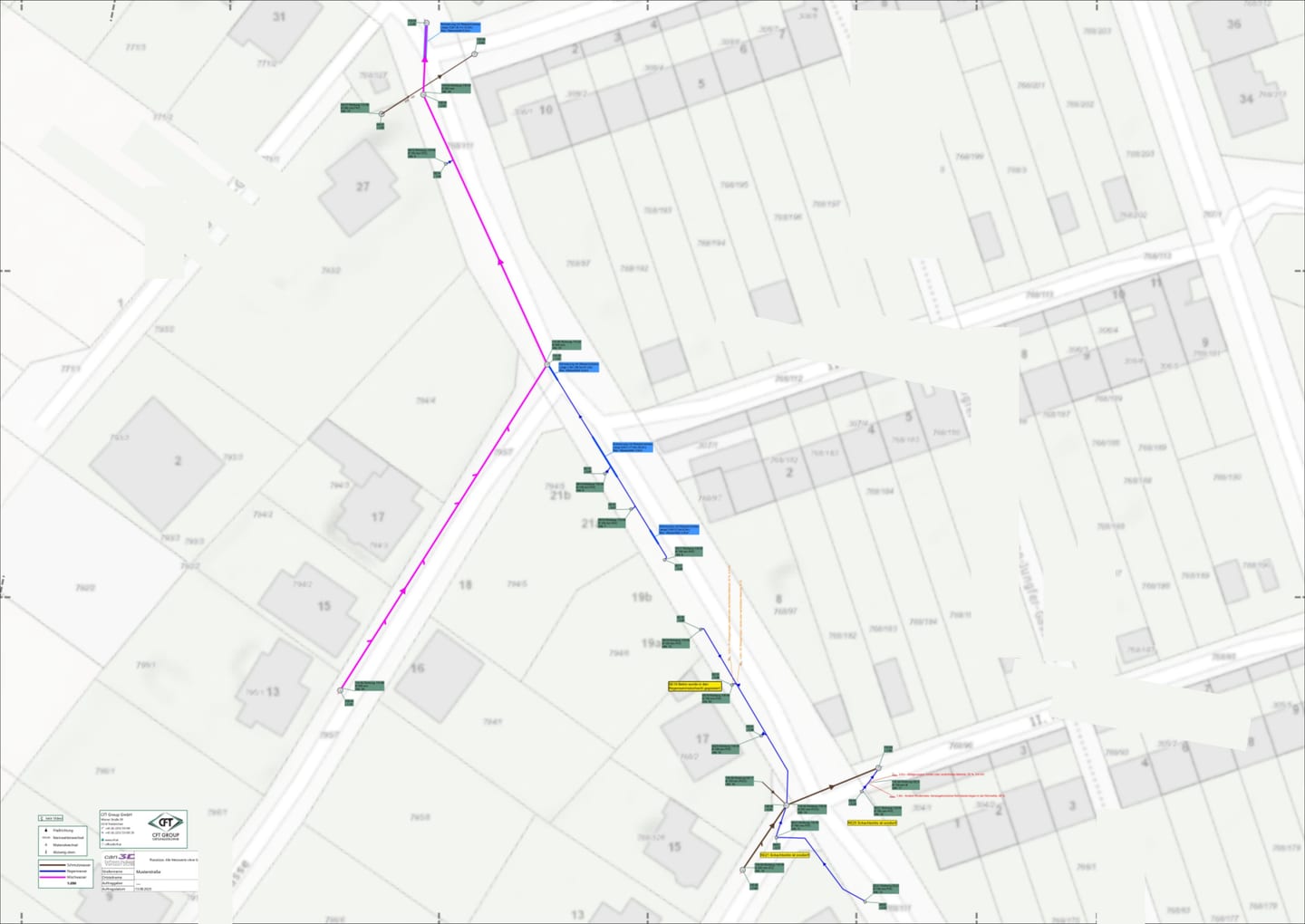
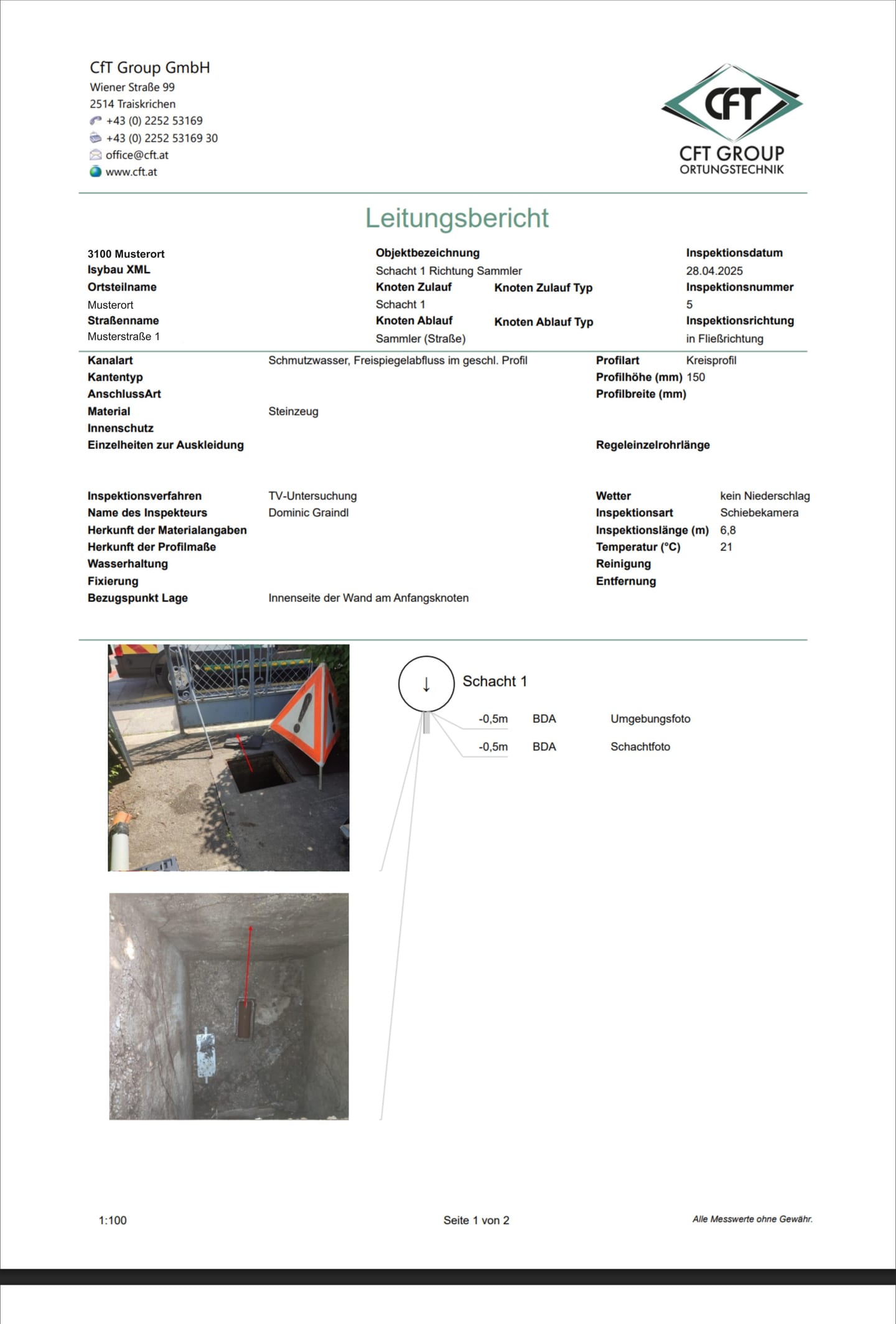
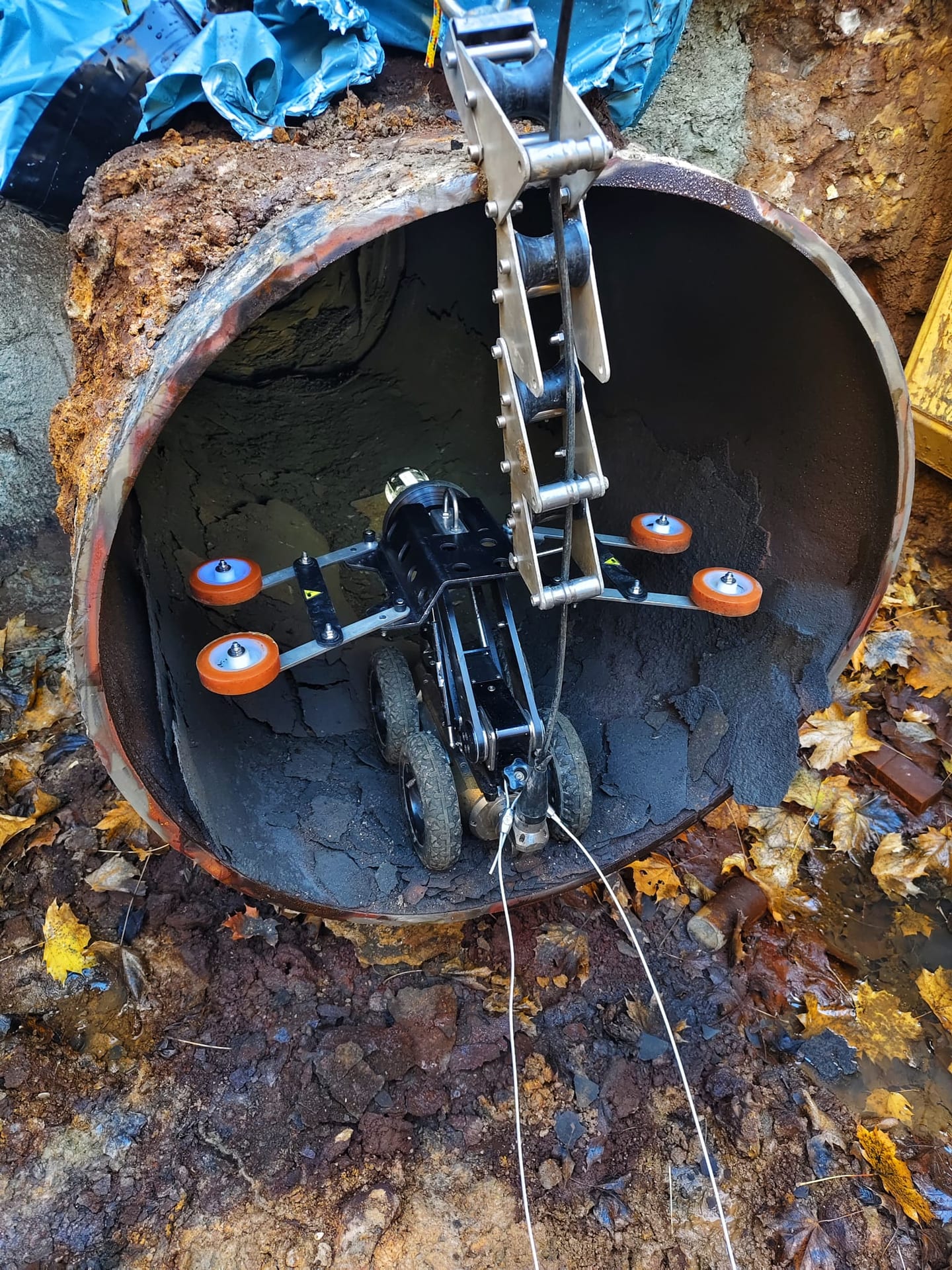
The same service in three nominal sizes – from DN 300 to DN 800, every run a real survey.
Costs and effort
There is no flat rate, because the effort depends on nominal diameter, the number of pipe runs, accessibility and the extent of the evaluation; we agree the cost range by telephone before the job. If the survey becomes necessary in the course of an escape of water, buildings insurance as a rule covers the leak detection costs under the trace and access cover; the record is produced so that it can be submitted to the insurer.
Frequently asked questions
Does the sewer have to be cleaned before the survey?
For a reliable assessment, yes. Deposits settle over the very places that are to be assessed. If it is only a matter of the route of a pipe, the survey run is sufficient without cleaning.
What pipe size do you reach, and how far in?
The crawler works from DN 100 to DN 1200, and the insertion length is up to 305 metres per access. If that is not enough for a stretch, the run is continued from the next manhole; which manholes have to be open for that we settle before the appointment.
Can I see in the video whether the sewer is leaking?
The camera shows the inner wall: cracks, broken sections, displaced joints, root ingress, deposits, intruding connections – it therefore shows the condition, not the tightness. Proof of tightness is a separate test with water or air; smoke testing, by contrast, answers the question of open paths, misconnections and escaping odour.
Do you repair the defect straight away as well?
No. CFT locates, marks, documents and hands over; the work is carried out by a plumber, pipe rehabilitation contractor or network operator. That is precisely why the record is detailed.
Contact and opening hours
CFT Group GmbH, Wiener Straße 99, A-2514 Traiskirchen, +43 (0) 2252 53169, for pipe runs in Vienna, Lower Austria and Burgenland. Monday to Thursday 8:00–16:30, Friday 8:00–12:00. Outside office hours in writing to office@cft.at, and we will come back to you on the next working day.
Related services
3D survey in the works network
When the question is not the condition of the pipe runs but the route of the network and its lateral connections.
Flues and misconnections
When there is an odour or a misconnection is suspected.
Network location and cable identification
When it first has to be settled where an unknown service actually leads.
Valve and hydrant surface boxes
When the manhole through which the survey is to be carried out cannot be found at all.
Describe the findings.
The more precisely you describe the findings, the more directly we can go to work. Plans, readings and photos help us settle the method in advance.
What happens next
- We read your message and match the case to a method.
- We come back to you – usually with a question that shortens the appointment.
- We confirm the appointment and what it costs before anyone sets off.
Rather talk?
+43 (0) 2252 53169
Mon–Thu 8:00–16:30 · Fri 8:00–12:00
Describe your case.
Fastest by telephone – then we settle straight away which method fits and what you should prepare.
Outside office hours, write to office@cft.at.