

Cable faults
Cable fault location on service and supply cables in Vienna, Lower Austria and Burgenland as well as parts of Upper Austria and Styria
The fuse trips, a phase is missing, the outbuilding stays dark: with buried service and supply cables the fault is almost never where you expect it. What costs money is not the measurement but the excavation and the repair – and it becomes most expensive when the ground is opened up without a finding and the excavation misses the fault. CFT surveys in the fault position, marks it on the surface and hands over a written finding; the repair is then carried out at one point instead of along the whole route. Report the outage on +43 (0) 2252 53169 or in writing to office@cft.at, and we will clarify responsibility, access and an appointment.

What we do on site
Before any locating we measure the condition: insulation and resistance readings say which cores are damaged, TDR prelocation says in which stretch of metres the fault sits. If the insulation value allows it, fault measurement follows directly, and the route is located at the same time. If it is too high, the cable first has to be surged and burned down – the installation is then out of service, and that calls for either a temporary supply arranged beforehand or the excavator on site to dig straight away.
Key facts at a glance
| Methods | Insulation and resistance measurement, time domain reflectometry (TDR), bridge measurement (Murray loop), surge and burn-down to make the fault earth-sensitive, Ley effect, sheath fault location on plastic-sheathed cables, electromagnetic cable locating, cable identification in trench and cable tray |
|---|---|
| Application range | Buried service cables and the supply cables beyond them: feeds to outbuildings and farm buildings, garages, workshops, pumps, lifting stations and sub-distribution boards on the property |
| Duration | At least 2 hours; each additional complication costs another hour. Two hours are usually enough for one or two faults. |
| Result format | Damage report as a PDF |
| Service area | Vienna, Lower Austria and Burgenland as well as parts of Upper Austria and Styria; from the Erding site additionally Bavaria and Baden-Württemberg |
For you as a private customer
The most important point comes before the measurement: the boundary of responsibility. Up to the service head (cut-out) the cable belongs to the network operator, beyond it to you. If the fault lies beyond it – in the feed to the garage, to the pump or to the sub-distribution board in the garden – you are our client and we start without a detour.
If it lies before that point, this is not a question of what we can do but of who places the order. We can measure out in the network as well; that is part of our work. Many local utilities, however, have their own measuring teams, and nobody works on their cable without their knowledge. Report an outage to the network operator first, therefore: either they come out themselves, or they instruct us. It is at this boundary that the expensive misunderstandings arise – not because it is unclear who can measure, but because it stays open who places the order.
If burning down is needed, the supply stops
Cable fault location is the last step, not the first – and whether it is possible directly at all is decided by the condition of the cable. If the insulation value is too high, the fault position yields nothing: the measuring pulse runs straight past it, and bridge measurement and the Ley effect find nothing to work with either. The cable then has to be surged and burned down so that the position becomes earth-sensitive. Only after that is a fault measurement possible.
During this process the installation is as a rule completely out of service, not just the faulty core: burning down frequently affects the neighbouring phases as well. What was still running in part beforehand may not run at all afterwards.
From this follows a question that has to be settled before the appointment: how will the time without power be bridged? Burning down happens in either case – the only question is what happens in the meantime.
Either a standby supply is in place before we start. The outage is then of no consequence, and burning down, measuring and pinpointing can be done without hurry.
Or the excavator is on site and opens up the ground as soon as the position is established, so that the repair can follow immediately. The installation is then without power only for as long as the repair takes.
What does not work is having neither of the two: the installation is then at a standstill after the burning down, and nobody is there to put it back into service. After the condition check we tell you whether burning down is needed at all – but please settle the question of standby supply or excavator with your electrician when you book.
How the job runs
1. Booking and clarification of responsibility. You describe the symptom and, if known, the route of the cable. We clarify in advance whether the section lies before or beyond the service head (cut-out), who isolates and de-energises it, and whether a standby supply is available should one be needed.
2. Isolation and condition check. The cable is isolated and de-energised at both ends and disconnected – as a rule this is done by your electrician; we take it on if you wish, and that belongs settled before the appointment rather than at the measuring point. Insulation and resistance are then recorded core by core. This establishes which cores are damaged and whether there is an open circuit, an earth fault or a short circuit.
3. Prelocation with TDR. A pulse runs through the cable and the echo says in which range of metres the fault sits. That is a distance along the cable, not yet a position in the garden.
4. The branch point: measure or burn down first. If the insulation value allows it, the fault measurement follows directly, and in the same operation the route is traced at the surface, because only distance and route together give a position. If the value is too high, the cable is surged and burned down beforehand – with the consequences for the supply set out above.
5. Pinpointing, marking and report. The position is narrowed down, marked and photographed. You receive the damage report; the repair is carried out by your electrician or by the network operator. CFT does not carry out repairs.
6. After the repair: check both sides. The cable is cut for the repair, and two sections result. Both belong to be measured for further faults before the trench is filled in again. Your electrician does this, or we come out for it once more.
Equipment and methods
Insulation and resistance measurement
At the start the question is not where the fault lies but what the cable still has to offer. Core by core the insulation value is measured against earth and against the remaining cores, and the resistance is recorded with it. From this we read off which cores are damaged and which type of fault is present. This finding decides everything that follows – it says whether measurement can go ahead directly or whether the fault position first has to be made earth-sensitive. Without it, any location work would be a matter of luck.
Time domain reflectometry (TDR)
Time domain reflectometry sends a short pulse into the cable and measures when the echo returns; every discontinuity reflects it differently, and from this the instrument calculates the distance. Besides the fault, the TDR trace also shows branches, cable joints and the cable end. The limitation: it gives a distance along the cable, not a position in the garden, and with high-resistance faults often no echo at all.
Bridge measurement (Murray loop)
Bridge measurement is a comparison of resistances: at the far end the faulty core and a sound core are joined into a loop; the fault position divides it into two sections whose resistances are in the same ratio as the corresponding lengths. It is the method of choice for earth faults and core-to-core faults, particularly where time domain reflectometry yields nothing. Its limitation: it requires access to both ends, a sound return conductor of the same cross-section and a low-resistance fault.
Surge and burn-down to make the fault earth-sensitive
A high-resistance fault is silent to measurement. The position is therefore subjected to surge voltage and burned down until it is low-resistance – earth-sensitive – because only then can it be located at all. This is not a minor intermediate step but an intervention in the cable: the installation is as a rule completely out of service while it happens, because the neighbouring phases are frequently damaged as well. It therefore has to be settled before the appointment whether a standby supply is available – or whether, instead of burning down, the ground is opened up and the cable repaired directly.
Ley effect
Where no clean reflection pattern comes about, the Ley effect helps to narrow things down: what is evaluated is how the applied locating signal changes along the route. Up to the fault position it behaves consistently and beyond it no longer does; the point at which it changes lies above the fault. That is a narrowing down and not a determination of the position to the centimetre; together with the distance known from the measurement it becomes the place at which the ground is opened.
Sheath fault location on plastic-sheathed cables
A sheath fault is damage to the outer plastic covering through which moisture enters; the installation often continues to run while the damage progresses. For location, a pulsed DC voltage is applied; the current leaves the cable at the damaged point and creates a voltage gradient which is picked up with two earth spikes and reverses direction above the fault. Its limitation: on asphalt and concrete the gradient cannot be picked up cleanly.
Electromagnetic cable locating
A locating signal is applied to the isolated and de-energised cable and traced at the surface. This produces the route line on which the measured distance is set out, together with a depth reading. The limitation: in densely occupied trenches the signal couples across to other services and the depth reading remains an approximate value, which is why the route is cross-checked several times.
Cable identification in trench and cable tray
In front of the house, power, telecoms and cable TV frequently share a trench, and the cables belong to different owners. Cable identification establishes, before anything is opened up, which cable is the one being sought, so that nobody ends up holding a third party’s live cable. Its limitation: if several cables are of identical construction and in service, the network operator has to be involved.

What you receive
You receive a marking on the surface and a damage report as a PDF. This provides the justification for the road opening and limits the area to be excavated.
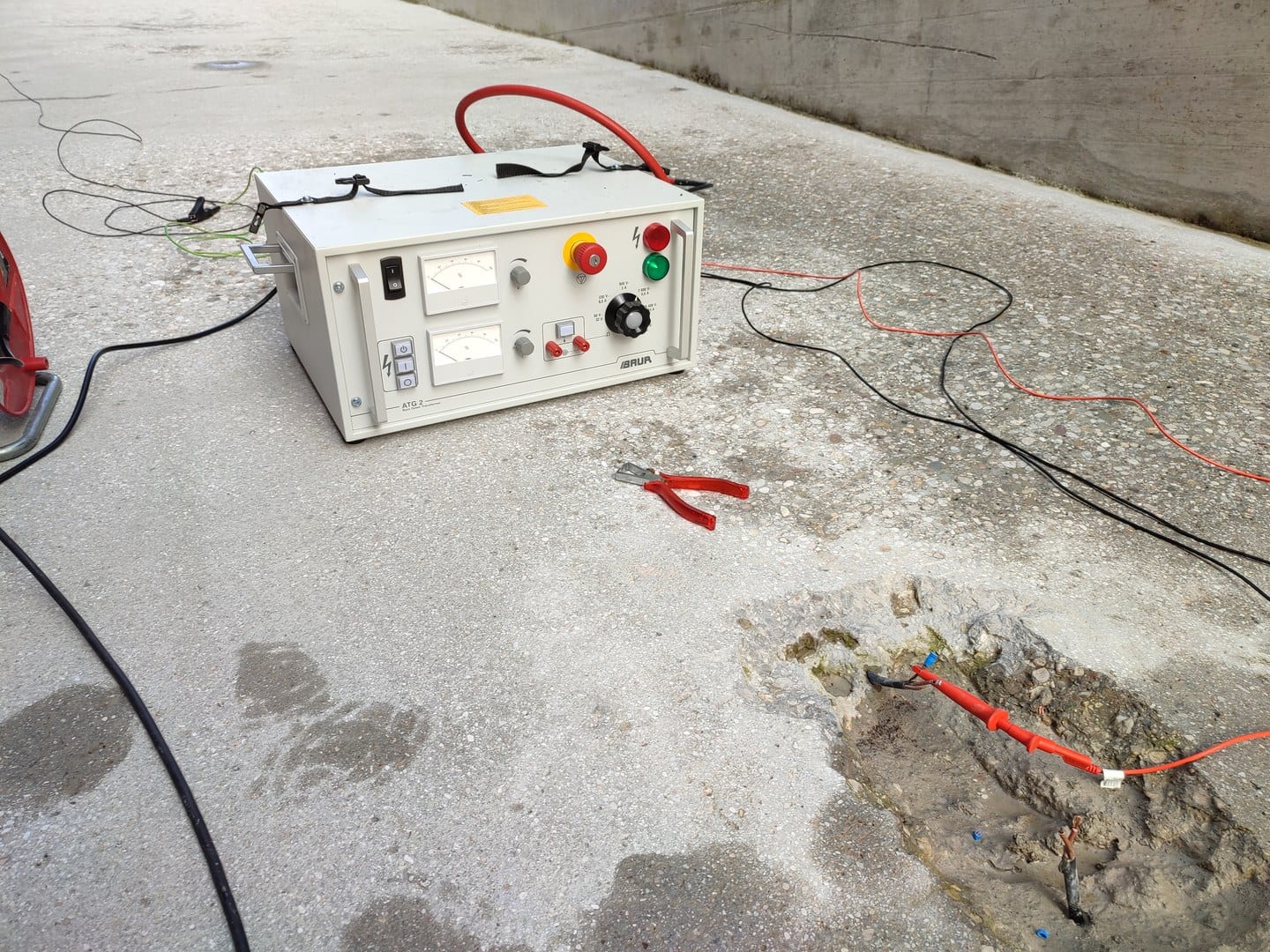
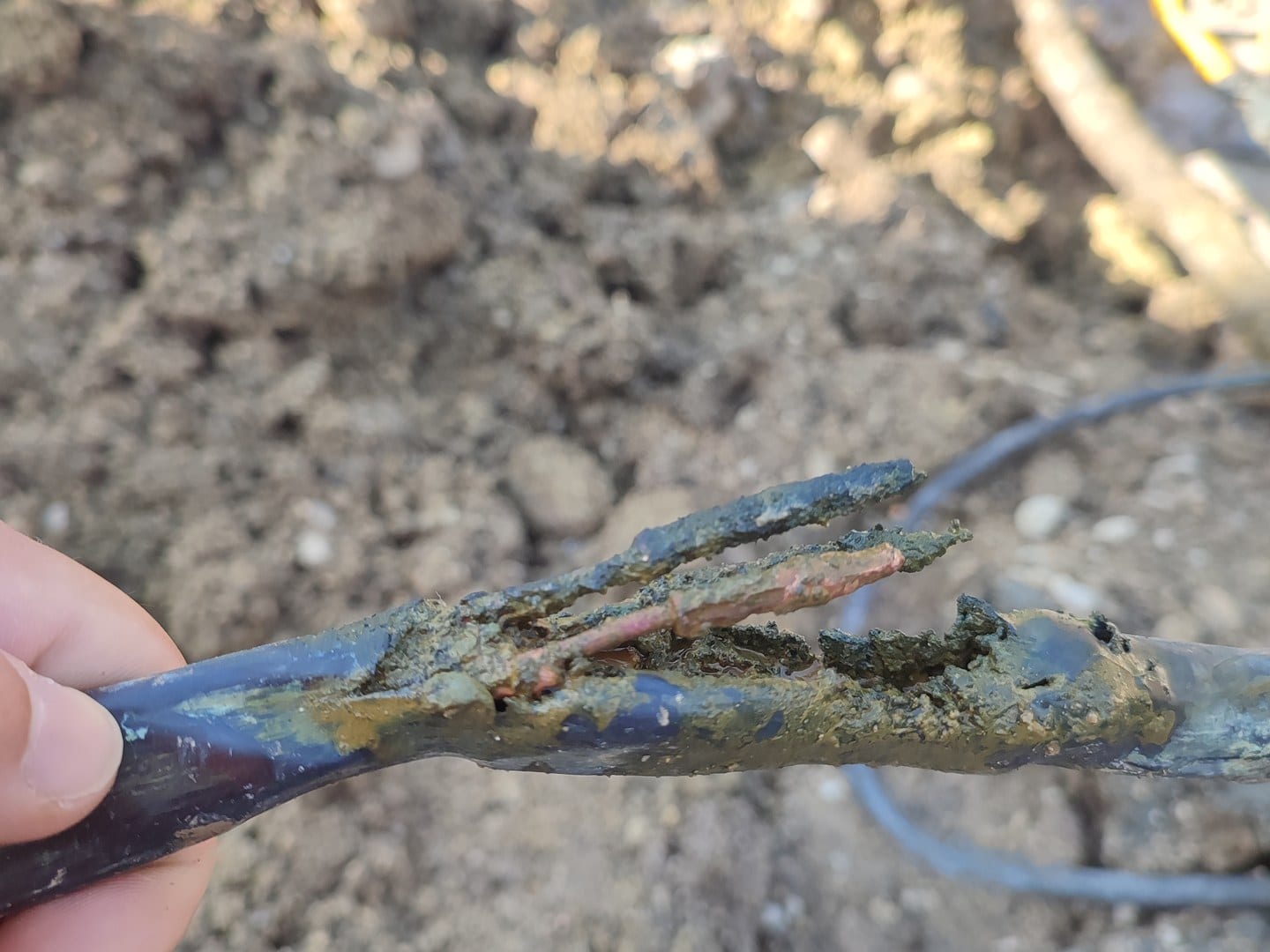
We show what we find.
A cable fault is invisible until you stand right above it. This is what it looks like when the measurement is right.
Costs and effort
There is no flat rate: the length and construction of the cable, the accessibility of the ends, the type of fault and the surface determine the effort involved. We tell you by telephone what you have to reckon with before an appointment is fixed.
A fixed rule applies to the re-survey, and it is set out here deliberately: the re-survey is part of the scope of services. If our measurement was wrong, it is free of charge. If it was correct and the search at the marked position was simply not precise enough or the excavation not deep enough, the call-out is charged. The reason in one sentence: in the second case there is no measurement error on CFT’s part.
Whether an insurer covers the cost of the location work depends on the policy.
Frequently asked questions
We have excavated and found nothing. What happens now?
We carry out a re-survey. If our measurement was wrong, it costs nothing. If it was correct and the search at the marking was simply not precise enough or the excavation not deep enough, the call-out is charged.
Who is responsible if the fault lies before the service head (cut-out)?
The network operator, because up to that point it is their cable. In measuring terms this is no different a job for us – we work out in the network as well. What the property owner cannot do is place the order there. Many local utilities have their own measuring teams in any case, so report the outage to them first; the operator then decides whether they come out themselves or send us.
Can you measure if nobody knows where the cable runs?
Yes, that is the normal case. The route is recorded and marked using electromagnetic cable locating before the distance from the prelocation is set out along it.
Does the installation have to be switched off for the measurement?
For measuring, in every case: the cable is isolated and disconnected at both ends, otherwise no insulation, resistance or time domain measurement is possible. Isolating is usually your electrician’s job; if you would rather leave it to us, please say so when you register. If burning down is needed as well, it goes further – the installation is then as a rule completely out of service, because the neighbouring phases are often affected too. If no standby supply is available for that, the more honest way is to excavate and repair directly after the prelocation.
The fault only occurs when it rains. Can you still measure?
Faults that depend on moisture are typical of damaged cable sheaths; sheath fault location exists for this. If the fault is not present at the time of measurement, it is harder to capture – tell us when it last occurred.
After the repair: why does it have to be measured again?
Because repairing means cutting, and one cable becomes two pieces. Both belong checked afterwards – a cable that has given way in one place often has a second. If it is merely patched and filled in again, the same excavation is due once more in a few weeks. This check measurement is done either by your electrician in the course of the repair, or we come for it.
Contact and opening hours
CFT Group GmbH, Wiener Straße 99, A-2514 Traiskirchen, +43 (0) 2252 53169, Monday to Thursday 8:00–16:30, Friday 8:00–12:00. For Bavaria and Baden-Württemberg: CFT Group Deutschland GmbH, Lange Zeile 27, D-85435 Erding, +49 (0) 173 6842932. We deliberately stay within our own area: short journeys and local knowledge of routes and network operators. Outside office hours, write to office@cft.at and we will come back to you on the next working day.
Related services
Telecoms, data and cable TV lines
When it is not the power that has failed but the telephone, internet or television signal. These lines often lie in the same trench.
Heating mats and heating cables
When the fault lies in the floor, wall or ramp construction.
Cable and pipe locating
When it first has to be established what is in the ground at all.
Describe what you are observing.
Just describe what you see – add a photo, and we can often settle on the right method before we even call back.
What happens next
- We read your message and match the case to a method.
- We come back to you – usually with a question that shortens the appointment.
- We confirm the appointment and what it costs before anyone sets off.
Rather talk?
+43 (0) 2252 53169
Mon–Thu 8:00–16:30 · Fri 8:00–12:00
Describe your case.
Fastest by telephone – then we settle straight away which method fits and what you should prepare.
Outside office hours, write to office@cft.at.