

Leak detection
Swimming pool leak detection in Vienna, Lower Austria and Burgenland
Is the pool leaking or is it only evaporating? The water level drops faster than evaporation explains, or it stops at the same height every time. Both are clues: the one points to the pipework, the other to a defect at that level in the pool. We first separate evaporation from real loss, then test the pool shell and the pipework separately and mark the point found. Report the water loss on +43 (0) 2252 53169 or in writing to office@cft.at, and we will settle the type of pool, access and the appointment for the leak search.

What we do on site
We put the question tight or not tight to each part of the installation separately, instead of suspecting the whole pool at once: to the built-in components with the vacuum bell, to the pipe runs with pressure from the plant chamber. In the end that establishes not only where the defect is but also whose repair it is – the pool operator or the plumber. Marking, record and sketch go with it.
Key facts at a glance
| Methods | Evaporation comparison, tightness test with the vacuum bell, pressure test of the pipework, visual inspection with a CCTV camera and locating sonde |
|---|---|
| Application range | Skimmer pools, deck-level (overflow) pools, natural swimming ponds, inlet and outlet pipework, plant chamber |
| Duration | Depending on the type and size of the pool, typically 2 to 5 hours |
| Result format | Marking above the defect, photographic report |
| Service area | Vienna, Lower Austria and Burgenland |
For you as a private customer
In summer an outdoor pool visibly loses water to evaporation, and that is exactly what makes the assessment difficult. What is informative is less the quantity than the pattern: if the level keeps dropping evenly, that points to the pipework; if it always stops at the same height, the defect is usually exactly there – at an inlet, at the skimmer, at a joint. Before the appointment, note down the water level with the date over several days; that is the most useful preparation. Be prepared as well for the pool having to be emptied beforehand, depending on the suspicion and the type of pool – only then can we reach all the inlet pipes and the skimmer. And once a defect has been repaired we advise a re-check: it evidences the quality of the repair and shows whether a second defect lies behind it. On request we will gladly carry out the re-check for you – as an appointment of its own, charged according to time spent and travel.
For you as a business
We put the question sound or not sound to each part of the installation individually, instead of suspecting the whole pool at once: the built-in fittings with the vacuum bell, the pipe runs with pressure from the plant chamber. What is established at the end is therefore not only where the defect is but whom the repair belongs to – the pool contractor or the plumbing contractor. The leaking pipe run is identified without a single square metre of paving having been opened up, and the sketch documents which pipe runs where. Marking, record and sketch are handed over for that purpose.
How the job runs
1. Preliminary clarification. We ask about the type of pool, the year of construction, the lining, where the plant is and the loss behaviour you have observed. With your notes on the water level, it is possible to narrow down on the telephone whether the pool shell or the pipework is the more likely candidate for testing.
2. Preparation on site. The plant chamber has to be accessible, the circulation has to be switchable on and off, and the pool surround has to be cleared.
3. Testing. If your evaporation comparison is available, the real loss is already known; otherwise we narrow it down on site. After that the pool shell and the pipework are examined separately: the built-in fittings with the vacuum bell, the pipes with pressure. At the end it has been established which part of the installation is leaking – that decides who carries out the repair.
4. Handover. You receive the photographic report for your pool contractor or plumbing contractor.
5. Check measurement after the repair. We recommend it, particularly after work on the pipework. It evidences that the repair holds – and it answers the question you cannot otherwise put to the pool: whether a second defect lies behind it. The reason for that lies in the matter itself and not in any want of care: what is found is always the stronger leak first, because it masks every weaker one for as long as it is open. Only once it has been closed can a second point show itself at all. The check measurement is therefore an appointment of its own and not part of the leak detection appointment; we announce it at the first visit. It is charged separately according to time spent and travel.
Equipment and methods
Evaporation comparison
A container filled with pool water is placed floating in the pool or on the pool edge; it evaporates under the same weather conditions as the pool surface but loses no water through leakage. The difference between the level in the container and the level in the pool over the same period is the actual loss – and incidentally it shows at what height the level comes to rest. Wind, bathing use, backwashing and rain distort the comparison, which is why use of the pool during the measurement period is recorded.
The good thing about this comparison: it needs no instrument and no technician, only a container, a sheet of paper and a few days of patience – which is why it is best left with you, and we are glad to explain on the telephone how it is done. It is not obligatory; we can narrow the loss down on site as well. But if your notes are already there, the visit does not begin with the question of whether the pool is leaking at all but straight away with the search for the point – that shortens the appointment noticeably, and you see the time saved directly on the invoice.
Tightness test with the vacuum bell
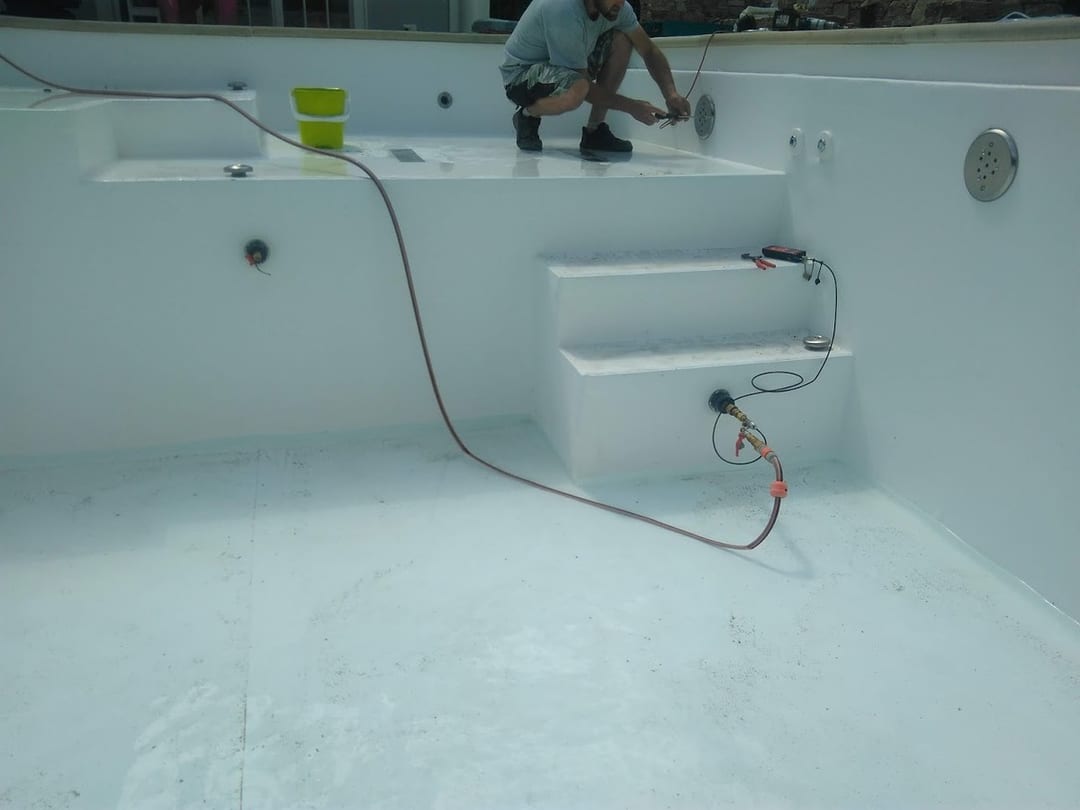
A bell built for exactly this purpose is placed over the suspect point – a liner weld, an inlet, the skimmer, a joint – and a negative pressure is built up beneath it. If the vacuum holds, the component is sound. If it falls away, the point is drawing air and the waterproofing is open there.
That is the difference from a visual inspection: the method assesses no area and weighs up no suspicion, it tests a single component and answers yes or no. For that the bell needs an accessible, exposed point – which is why the suspicion decides whether the pool is emptied for the test.
For the same reason, repeating it after the repair is not an extra but the second part of the same method: only that shows, at the same component, whether the point has become sound.
Pressure test of the pipework
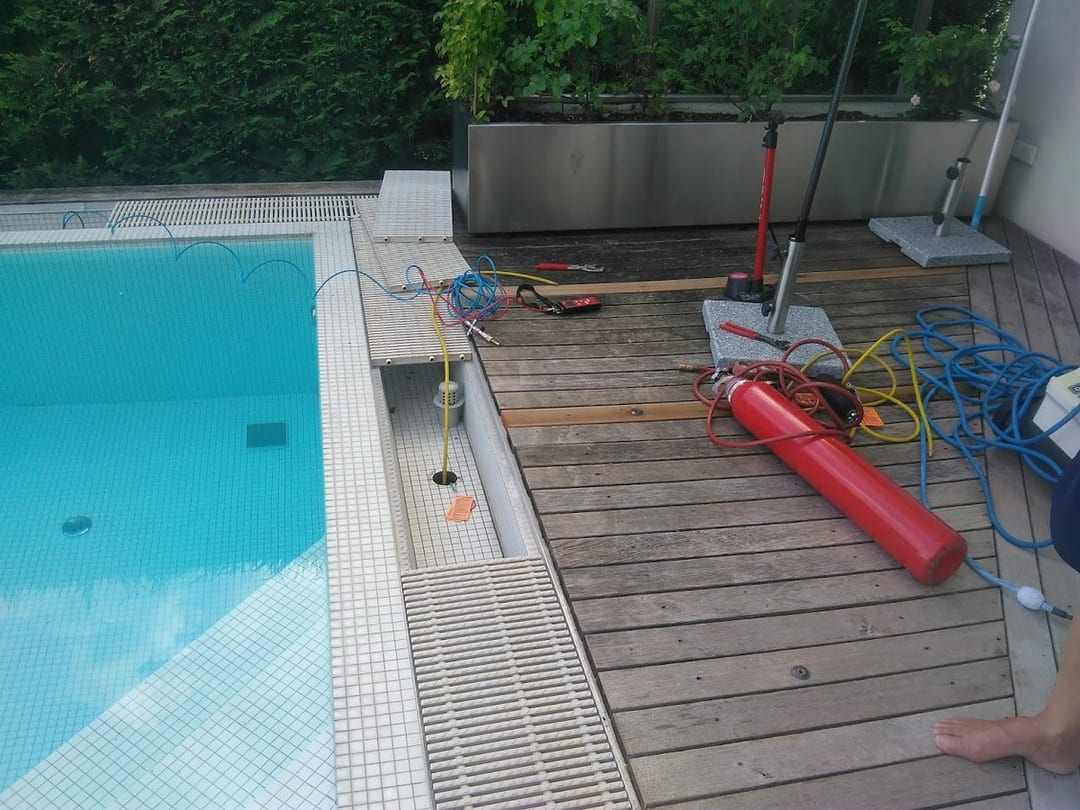
Individual pipe runs are isolated in the plant chamber and put under pressure. If one run holds the pressure and another does not, the leaking pipe has been identified without a single square metre of paving having been opened up. Solvent-welded collector pipes without a separation point cannot be assessed individually.
Visual inspection with a CCTV camera and locating sonde
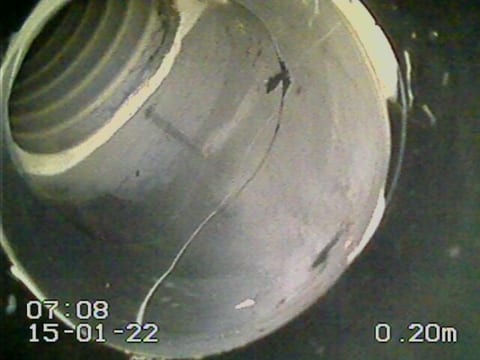
An ultra-flexible camera for pipe diameters from DN 30 to DN 70 is pushed into the inlet pipes and the rest of the pipework. It is built for exactly those tight cross-sections and bends at which an ordinary drainage camera can go no further. With it we see a defect that the pressure test or the vacuum bell has narrowed down directly in the pipe – a crack, an open socket, a solvent-weld joint that has come apart. Confirmation with our own eyes takes the last residual risk out of the repair: opening up only happens once it has been established what lies there.
A locating sonde additionally sits in the camera head. With the camera standing at the damaged point, its signal is taken as a bearing at the surface – the marking therefore sits exactly above the image that shows the defect, not above a calculated distance. The route of the pipe for the pipework sketch is run along in the same way. A separate locating run with a separate sonde is thereby unnecessary; only reinforcement in concrete can pull the bearing off line.

What you receive
You receive the marking above the defect and the photographic report.
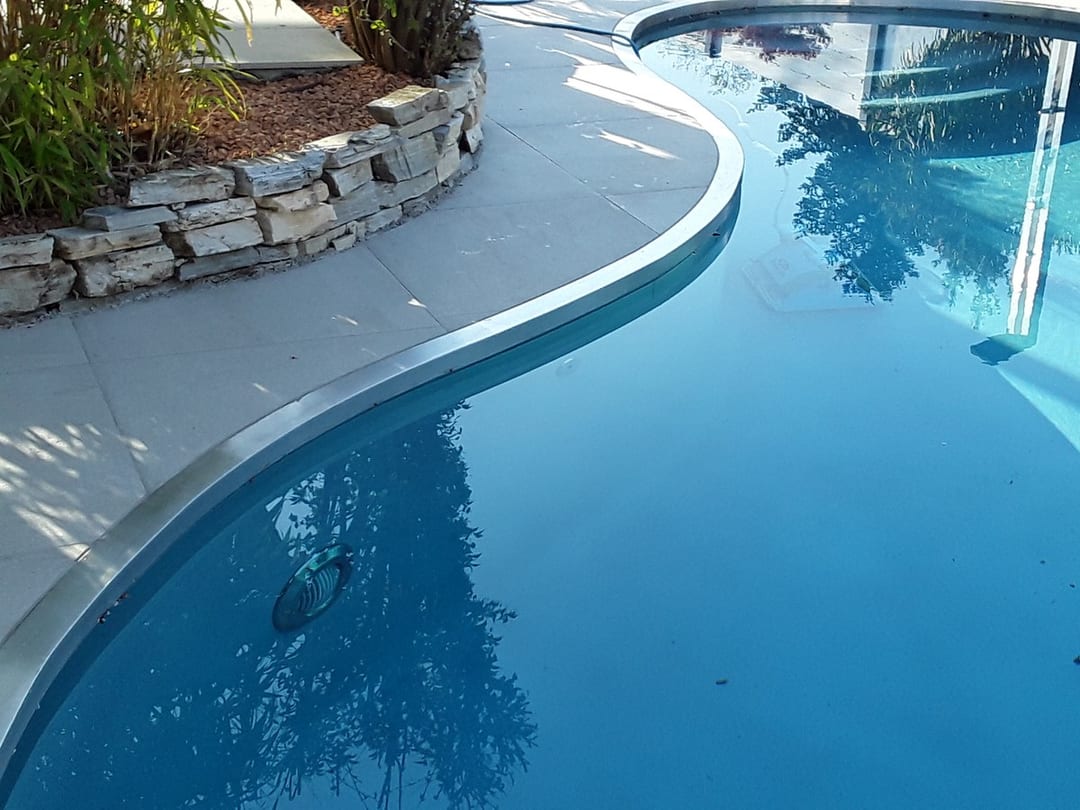
How the leak comes to light.
Four stages from real jobs – from the full pool to the spot found.

Costs and effort
We do not state a price or a flat rate, because the type of pool, the length of the pipework and accessibility determine the effort – and because your notes on the water level lower it noticeably; we agree the cost range by telephone before the job. Whether your buildings insurance covers damage to a pool depends on the policy – unlike an escape of water inside the building, that is not the rule.
The check measurement after the repair is part of the method, but is an appointment of its own on a different day. It is charged separately according to time spent and travel. We say so before the first visit, so that it does not come as a surprise on the invoice later.
Frequently asked questions
How much water loss is still normal?
There is no generally valid figure, because evaporation depends on air and water temperature, wind, the cover and bathing use. What is assessed is therefore the difference from the evaporation comparison.
Do I have to empty the pool for the location work?
That depends on the suspicion and on the type of pool, and we tell you before the appointment. The vacuum bell needs an exposed, accessible point – for liner welds, inlets and the skimmer that as a rule means: an empty pool. An empty pool is not left unwatched while this is going on, as it can move through buoyancy or earth pressure.
The level always stops at the height of the return inlets. What does that mean?
That the defect is very probably at that height – once the level drops below it, nothing more can run out. That narrows the search down to the built-in fittings and the pool wall.
Does this apply to natural swimming ponds as well?
Yes, with a different emphasis: with near-natural installations the loss is more often due to the liner, to the transition to the regeneration zone or to points penetrated by roots.
Contact and opening hours
CFT Group GmbH, Wiener Straße 99, A-2514 Traiskirchen, +43 (0) 2252 53169, Monday to Thursday 8:00–16:30, Friday 8:00–12:00. Outside office hours in writing to office@cft.at, and we will come back to you on the next working day.
We come to pools in Vienna, Lower Austria and Burgenland.
Related services
Burst and leak detection in and around buildings
When the supply pipe to the plant room is affected.
Flat roof leak detection
For waterproofing levels above occupied rooms.
Pipe and utility detection
When the route is to be documented before excavation.
Water damage investigation
When pool water is saturating adjoining building elements.
Describe what you are observing.
Just describe what you see – add a photo, and we can often settle on the right method before we even call back.
What happens next
- We read your message and match the case to a method.
- We come back to you – usually with a question that shortens the appointment.
- We confirm the appointment and what it costs before anyone sets off.
Rather talk?
+43 (0) 2252 53169
Mon–Thu 8:00–16:30 · Fri 8:00–12:00
Describe your case.
Fastest by telephone – then we settle straight away which method fits and what you should prepare.
Outside office hours, write to office@cft.at.