

Leak detection
Leak detection on heating systems in Vienna, Lower Austria and Burgenland
If you have to top up the heating every few days, the system is losing water – somewhere between the boiler, the manifold and the last metre of heating circuit in the screed. We narrow the loss down to one circuit and then locate the point, without opening up the floor on suspicion. The repair is carried out by your plumber, at the marked point. We cover Vienna, Lower Austria and Burgenland – a short journey, appointments at short notice and local knowledge. Report the pressure loss on +43 (0) 2252 53169 or in writing to office@cft.at, and we will settle the system, access to the manifold and the appointment.

What we do on site
Not every drop in pressure is a leak: an expansion vessel, a safety valve or air in the system produces the same picture. We check that first and only then narrow down circuit by circuit; the point found is marked and assigned to its heating circuit.
Key facts at a glance
| Methods | Pressure loss analysis over time, tracer gas, thermography on the heating circuit, circuit-by-circuit isolation at the manifold |
|---|---|
| Application range | Underfloor and wall heating, risers and distribution pipes, radiator connections, buried local district heating pipes |
| Duration | Typically 1 to 3 hours |
| Result format | Marking on the screed or building element, photographic report |
| Service area | Vienna, Lower Austria and Burgenland |
For you as a private customer
The first sign is almost always the needle of the pressure gauge: it reads correctly after topping up and falls again afterwards. Sometimes a spot in the floor that feels warmer is added to the picture. Not every drop in pressure is a leak – a faulty expansion vessel, a leaking pressure relief valve or air in the system produce the same picture but cost a fraction. That is what we check first.
For you as a business
In housing developments, schools and commercial buildings, the narrowing down decides how much floor area has to be opened up: at the manifold each circuit is isolated individually, which reduces the area to be examined from the whole flat to a single room. Before that, causes on the plant side are ruled out, because not every drop in pressure is a leak. What is handed over is the assignment of the leaking circuit, the marking of the point found and the photographic report – the document that goes to the plumber and to the insurer.
How the job runs
1. Preliminary clarification. We ask about the type of system, its age, the type of heat emission and how often you top up. Please note down the pressure gauge readings with date and time before the appointment.
2. Preparation on site. The plant room, manifold cabinets and isolating valves have to be accessible and in working order.
3. Location. First the loss is confirmed and causes on the plant side are ruled out, then it is narrowed down circuit by circuit and finally the point is located. The point found is marked, photographed and assigned to its heating circuit.
4. Handover and check measurement. You receive the photographic report for your plumber and your insurer. Where a heating circuit is found not to be sound, we choose the method appropriate to the rate of loss in order to search for the leak. Because heating pressure and pressure drop can only be assessed over time and not in a single appointment, a check measurement is part of the method: we record the pressure trace again at a later date and compare it with the first trace. We announce the second appointment at the first one; it is charged separately according to time spent and travel.
Equipment and methods
Pressure loss analysis over time
Before anything else comes the preliminary check: is the heating losing water at all, or is something else behind it? The more precisely that has been settled in advance, the better. Where the suspect circuit is already known, we test in a targeted way and reach a result more quickly.
Testing is only possible on a system that has cooled down and is at room temperature – and that applies even when the circuit has already been narrowed down. If the system is still warm at the appointment, we flush it through on site; depending on the size of the heating system that takes several hours. Only after that is it prepared. Each circuit is then tested individually.
On request we take on the preliminary check ourselves. It then needs several check appointments at which the system is observed, before the pressure test proper and the search for the leak begin.
Tracer gas
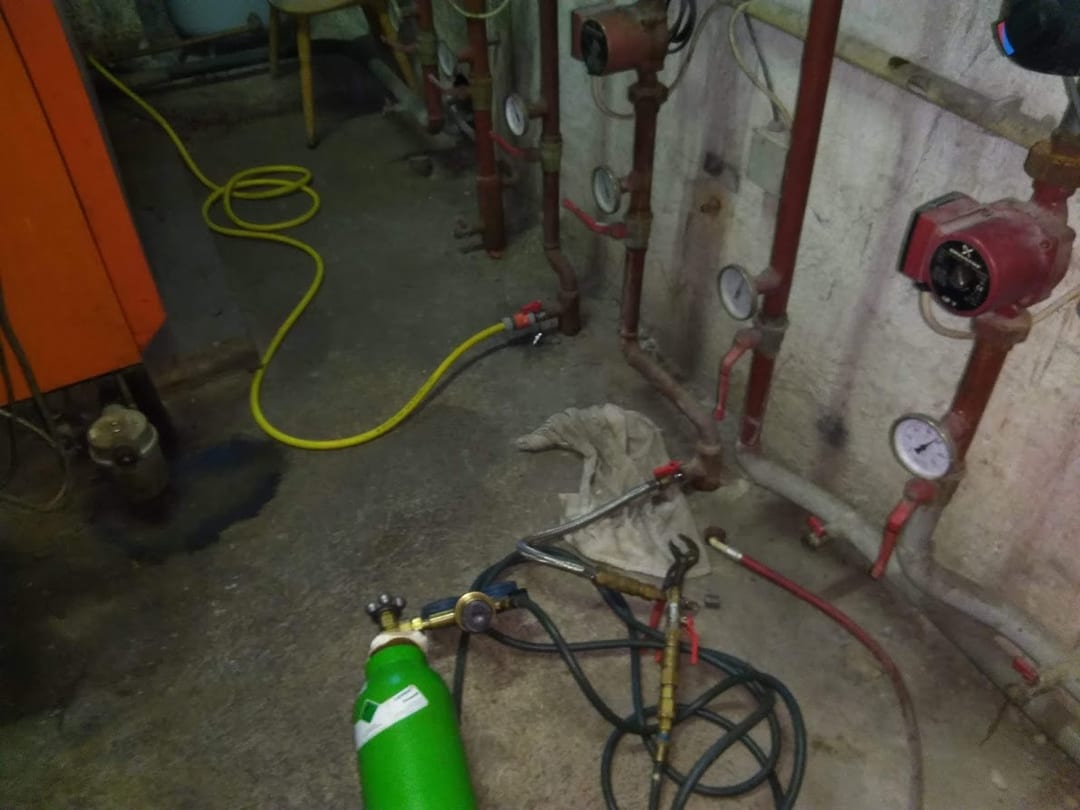
The circuit is drained and filled with a test gas: its hydrogen content escapes even at the smallest defects, rises through screed and floor covering and is indicated at the surface by the gas detector; in the mixture used, the gas is not ignitable. Dense floor coverings and membranes deflect it sideways, so that the point of emergence can lie next to the defect.
Thermography on the heating circuit
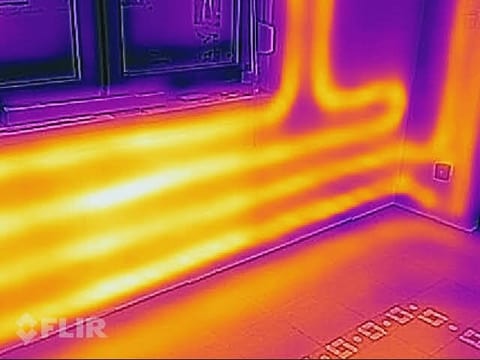
If a single circuit is run warm while the others stay isolated, its route stands out in the thermal image, and a point of escape often shows as a zone of differing warmth. With thick screeds or carpet the route can only be made out faintly.
Circuit-by-circuit isolation at the manifold
At the heating manifold each circuit is isolated individually and it is observed which one does not hold the pressure. This step costs little and reduces the area to be examined from the whole flat to a single room; it requires an accessible manifold with functioning isolating valves.

What you receive
You receive the assignment of the leaking circuit at the manifold, the marking of the point found and the photographic report with photographs and methods. Where thermography was used, the thermal images are enclosed – they show the pipe layout and help to avoid hitting a neighbouring pipe when opening up.
We show what we find.
Burst pipe on the heating, found with the thermal image – three real findings, plus the documented pressure test.

Costs and effort
We do not state a figure, because the size of the system, the number of heating circuits, the floor build-up and accessibility determine the effort; we agree the cost range by telephone before the job. If water escapes from the heating system into the building, that is an escape of water – buildings insurance will then as a rule pay for the leak detection under trace and access cover, and our record is produced ready for submission.
Check measurements are part of the method but are an appointment of their own: they are charged separately according to time spent and travel. We say so beforehand, so that there is no surprise on the invoice.
Frequently asked questions
Should I top up before the appointment, or precisely not?
Please do not top up shortly before the appointment: an undistorted pressure trace is the best starting point. Note down the pressure gauge readings with the date instead.
Can the pressure drop occur without a leak?
Yes, more often than assumed. An expansion vessel that has lost its charge pressure, a dripping pressure relief valve or air in the system produce the same symptom – and are put right without any work on the screed.
Can measurements be taken in winter?
Yes. For the pressure test the system has to have cooled down in any case – in winter that means switching the heating off in good time before the appointment, otherwise we flush it through on site. For thermography a temperature difference is actually needed, and for the tracer gas measurement the circuit is drained and therefore temporarily cold.
Can a leak in underfloor heating be found without breaking open the floor?
The location work is non-destructive and is carried out from the surface. Opening up only happens after the marking, at one point, by your plumber.
Contact and opening hours
CFT Group GmbH, +43 (0) 2252 53169, Monday to Thursday 8:00–16:30, Friday 8:00–12:00. Outside office hours in writing to office@cft.at, and we will come back to you on the next working day.
Related services
Burst and leak detection in and around buildings
When the drinking water or hot water pipe is losing water.
Water damage investigation
When walls or ceilings are already saturated.
Structural drying
When the screed has to be dried after the repair; the drying itself we refer on.
Cable faults in heating mats and heating cables
When an electric surface heating system fails.
Describe what you are observing.
Just describe what you see – add a photo, and we can often settle on the right method before we even call back.
What happens next
- We read your message and match the case to a method.
- We come back to you – usually with a question that shortens the appointment.
- We confirm the appointment and what it costs before anyone sets off.
Rather talk?
+43 (0) 2252 53169
Mon–Thu 8:00–16:30 · Fri 8:00–12:00
Describe your case.
Fastest by telephone – then we settle straight away which method fits and what you should prepare.
Outside office hours, write to office@cft.at.